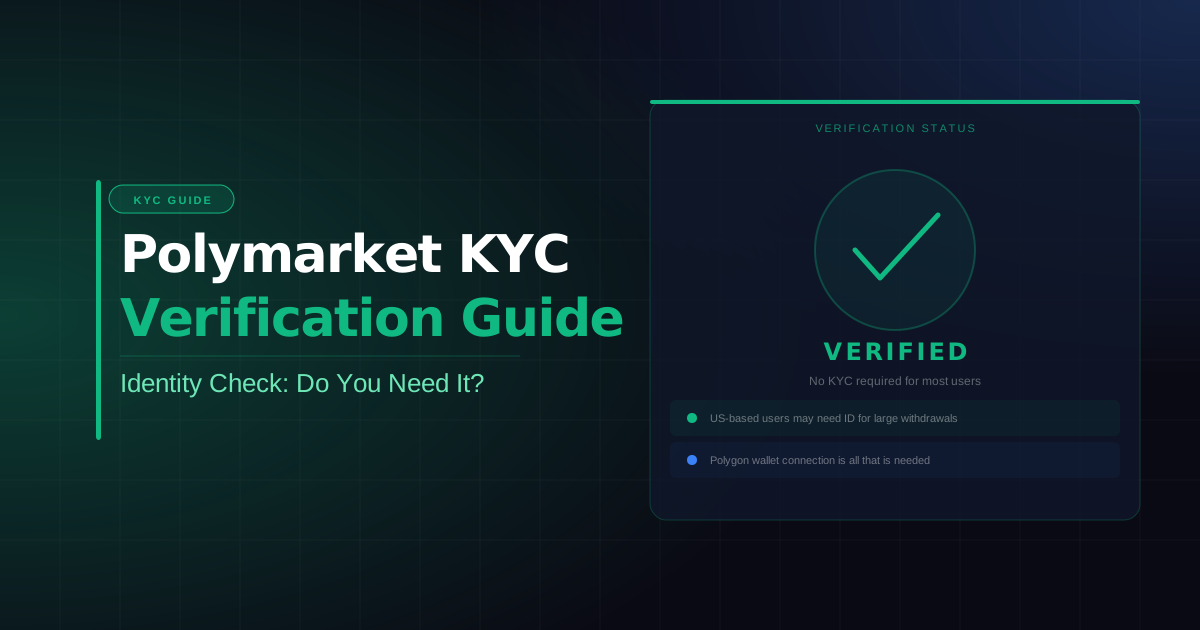
Polymarket does not require you to submit a passport, upload a selfie, or verify your address. For the vast majority of users, the only thing needed to start trading is a Web3 wallet and a compatible internet connection. Yet confusion about Polymarket's KYC requirements is widespread — partly because the platform has had a high-profile regulatory history, and partly because the way it handles compliance is genuinely different from anything most traders have encountered before. This guide explains exactly what Polymarket does and does not require, why the architecture produces this outcome, and what it means practically for US users, high-volume traders, and anyone wondering what information Polymarket can actually see about them.
The Short Answer: No Traditional KYC for Most Users
Polymarket is a non-custodial, blockchain-based prediction market. When you use it, you are not creating an account with a company that holds your money. You are connecting a self-custody wallet — typically via MetaMask or a Polymarket-generated embedded wallet — and interacting directly with smart contracts on the Polygon network. Because there is no account creation in the traditional sense, there is no point in the onboarding flow where Polymarket asks for your name, date of birth, government-issued ID, or proof of address.
What Polymarket does require is a wallet connection — typically set up via MetaMask — and a geographic check. When you visit the platform, your IP address is evaluated against a list of restricted jurisdictions. If you pass that check, you connect your wallet and trade. No identity documents change hands at any stage of this process. This is structurally different from platforms like Kalshi, Coinbase, or any traditional brokerage, where KYC document submission is mandatory before you can fund an account. For a full comparison of how Polymarket and Kalshi differ on this and other dimensions, see our Polymarket vs Kalshi guide.
Why Polymarket Has No Traditional KYC: The Architecture Explanation
The absence of traditional KYC is not an oversight or a regulatory grey area — it is a direct consequence of how the platform is built.
Polymarket is non-custodial. This means the platform never holds your funds. Your USDC sits in your own wallet until you place a trade, at which point it moves to a smart contract escrow. When the market resolves, the smart contract distributes winnings directly back to wallet addresses. Polymarket the company is not an intermediary holding and disbursing funds in the way that a bank, broker, or centralized exchange is. Custodial financial services trigger KYC obligations under anti-money-laundering (AML) frameworks precisely because the custodian is responsible for the movement of client funds. A non-custodial smart contract protocol sits outside that framework.
There are no user accounts in the database sense. Your "account" on Polymarket is your wallet address. There is nothing to verify because there is no account record tied to a person — only a public blockchain address. The platform cannot freeze your "account" because there is no account to freeze; your wallet is controlled entirely by your private key, which Polymarket never has access to.
The CFTC settlement in January 2022 — which resulted in a $1.4 million fine and a requirement to block US users — addressed the question of whether Polymarket's event contracts constituted unregistered binary options. It did not require Polymarket to implement KYC across its user base. The resolution was geographic restriction, not identity verification. For a detailed look at the regulatory picture and how it has evolved since the US re-opened in February 2026, see our guide on whether Polymarket is legal in the US.
Want to trade Polymarket markets without managing wallets or geo-checks? PolyCopyTrade automatically mirrors the positions of Polymarket’s top traders — no extra KYC, no additional verification layer. Get started today.
What Polymarket Actually Does Require
While traditional KYC is absent, Polymarket does implement a set of access controls that function as a compliance layer:
Wallet Address
A wallet address is your identity on Polymarket. It is pseudonymous — it is not linked to your legal name by Polymarket — but it is a permanent, public identifier on the blockchain. Every trade you make, every market you enter, every payout you receive is publicly recorded against your wallet address. Polymarket can see your full on-chain activity, and so can anyone else with a blockchain explorer. This is not anonymous; it is pseudonymous. If your wallet address is ever linked to your real identity through an exchange withdrawal or other on-chain activity, your Polymarket history becomes visible.
Geo-IP Check
When you load the Polymarket interface, your IP address is checked against a list of restricted jurisdictions. This is the primary access control mechanism. Restricted countries — those subject to OFAC sanctions or previously flagged by Polymarket's compliance framework — cannot access the platform interface. The check happens at the IP layer, not the wallet layer; your wallet address itself is not geo-restricted on the Polygon blockchain, but the Polymarket front-end will refuse to load for blocked IPs. For a full breakdown of which countries are currently affected, see our Polymarket countries guide.
VPN Detection
Polymarket employs VPN and proxy detection alongside the IP geo-check. Known VPN IP ranges, data centre IPs, and Tor exit nodes are flagged and blocked. This is designed to prevent users in restricted jurisdictions from bypassing the geo-check via a VPN. The detection is not perfect — residential VPN IPs and some newer VPN services can evade it — but the intent is clear.
GPS Check on Mobile
Polymarket's mobile interface can request GPS location data from your device. If GPS and IP location are inconsistent, or if your GPS position falls within a restricted jurisdiction, access may be denied even if your IP appears to originate from an allowed country. Mobile users in borderline situations should be aware that this additional check exists.
US Users Specifically: What Changed After the CFTC Settlement
The US situation deserves its own section because it has the most complicated history and the most recent change.
From January 2022 to February 2026, US residents were geo-blocked from accessing Polymarket. The CFTC settlement required Polymarket to implement this restriction. For four years, American users who wanted to participate had to use a VPN — which was a breach of Polymarket's Terms of Service — or simply sit out.
In February 2026, Polymarket lifted the US geo-block entirely. American residents across all 50 states can now access and trade on the platform without any workaround. This change reflects Polymarket's revised compliance framework and a broader shift in the US regulatory environment toward prediction markets under the current administration. Polymarket is now accessible to US users via direct wallet connection, with no additional KYC layer imposed specifically for American users.
The current US access model is the same as the rest of the world: wallet connection plus passing the geo-IP check. There is no US-specific identity verification requirement, no SSN collection, and no reporting to the IRS at the platform level. This may evolve as US regulation of crypto-asset platforms develops, but as of March 2026, US users are treated identically to users in the UK, EU, or Canada.
How Polymarket Detects Restricted Jurisdictions Without Asking for ID
The mechanism is entirely technical rather than documentary. Polymarket does not need to know who you are to determine where you are. The detection stack works as follows:
- IP geolocation. Your IP address is mapped to a country and region using commercial geolocation databases. This is the first and most consistent check.
- ASN (Autonomous System Number) analysis. The network provider of your IP is checked. Data centre ASNs and known VPN providers are flagged independently of the IP's apparent country.
- GPS location on mobile. If you are using a mobile browser or the Polymarket mobile interface, location permissions may be requested. GPS data is accurate to within a few metres and is harder to spoof than IP address.
- Browser fingerprinting signals. Language settings, timezone, and system locale can indicate a mismatch between apparent IP location and actual device location.
None of these checks require you to provide any identifying documents. They are passive signals collected at the moment of access. Polymarket's compliance layer makes a binary decision — allow or block — based on these signals, without ever learning your name, address, or any other personal identifier. This is how Polymarket maintains compliance with its geographic restrictions while operating a non-custodial, non-account-based platform. For more on the overall security model, see our guide on whether Polymarket is safe.
Copy Polymarket’s top traders automatically. PolyCopyTrade gives you exposure to Polymarket’s best performers with zero additional verification requirements. No passport. No selfie. No ID. Start copy trading today.
Can You Use a VPN on Polymarket?
This is one of the most searched questions about Polymarket, and the honest answer has two parts.
Technically, a VPN that uses residential IP addresses (rather than data centre IPs) can sometimes bypass Polymarket's geo-check. The platform's VPN detection is not infallible, and some VPN providers specifically market "residential IPs" for exactly this purpose.
Practically, using a VPN to access Polymarket from a restricted jurisdiction creates serious problems:
- Terms of Service violation. Polymarket's ToS explicitly prohibits use from restricted jurisdictions. Circumventing the geo-block via a VPN is a breach of those terms. If detected — and detection methods improve over time — your wallet could be blocked from the Polymarket interface.
- USDC on/off-ramp complications. Getting USDC into and out of your wallet requires using an exchange or payment processor. Those intermediaries have their own KYC and geo-restrictions. If you are in a sanctioned country, you likely cannot legally acquire or redeem USDC regardless of what the Polymarket interface shows.
- No recourse. If your access is terminated for ToS violation, there is no appeals process and no financial protection for positions that were open at the time. Your funds in open positions may be locked until market resolution, and you may be unable to withdraw.
- Risk concentration for users in unrestricted countries. If you are in the US, UK, EU, Canada, India, or most other accessible jurisdictions, you do not need a VPN. Using one introduces unnecessary complexity and small but real risk without any benefit.
For users in genuinely blocked jurisdictions such as Russia, Iran, or Cuba, a VPN does not resolve the underlying USDC infrastructure restrictions or the legal exposure from trading in violation of OFAC regulations.
What Information Polymarket Can See About You On-Chain
Polymarket operates on a public blockchain. This means that while the platform does not have your name or ID documents, it has something potentially more revealing: a complete, permanent, public record of every trade you have ever made under your wallet address.
Anyone — including Polymarket, regulators, blockchain analytics firms, and the general public — can see:
- Every market you have traded in
- The exact size and timing of every position
- Your profit and loss on every resolved market
- All wallet-to-wallet transfers associated with your address
- The exchange or protocol where you first acquired your USDC
This last point is important. If you bought your USDC on Coinbase — which requires full KYC — and then sent it to your Polymarket wallet, an on-chain analysis can connect your Coinbase-verified identity to your Polymarket trading history. Polymarket itself does not make this connection, but blockchain analytics companies specialise in exactly this kind of wallet clustering. High-volume traders in particular should be aware that their Polymarket activity is not private in any meaningful sense, even though no ID was ever submitted to Polymarket directly.
High-Volume Traders: Withdrawal Thresholds and Reporting
Polymarket itself does not impose withdrawal thresholds that trigger additional identity verification. Because withdrawals are blockchain transactions — you are simply moving USDC from a smart contract back to your self-custody wallet — there is no Polymarket employee processing a withdrawal request or applying a reporting threshold.
However, the off-ramp from USDC to fiat currency is where reporting obligations can arise. If you convert large amounts of USDC to fiat via an exchange such as Coinbase, Kraken, or Binance, those exchanges are subject to Bank Secrecy Act (BSA) reporting requirements and may file Currency Transaction Reports (CTRs) or Suspicious Activity Reports (SARs) for large or unusual transactions. The exchange, not Polymarket, triggers these reports.
For US traders in particular, USDC earnings from Polymarket are taxable income or capital gains depending on how positions are structured. The IRS expects taxpayers to self-report these earnings. Polymarket does not send 1099 forms. This is a meaningful difference from Kalshi, which as a CFTC-regulated entity has different reporting obligations. For full guidance on how Polymarket earnings are taxed in the US and other jurisdictions, see our Polymarket tax guide.
How This Compares to Kalshi and Traditional Platforms
The contrast with Kalshi is stark. Kalshi is a CFTC-designated contract market operating under full US financial regulation. To open a Kalshi account you must:
- Submit a government-issued photo ID
- Provide your Social Security Number or ITIN
- Pass an identity verification check
- Agree to 1099 reporting
This is the same process as opening a brokerage account with Fidelity or Schwab. Kalshi holds your funds (it is custodial), issues tax forms, and operates as a regulated financial intermediary. The KYC requirement is mandatory and non-negotiable.
Traditional sports betting platforms, prediction market apps, and any platform operating under a gambling or financial services licence similarly require full KYC before funding is permitted. The Polymarket model — wallet connection only, geo-check at the interface level — is distinctive to non-custodial blockchain platforms. The full comparison of features, markets, and regulatory structures is covered in our Polymarket vs Kalshi article.
PolyCopyTrade: No Additional KYC Layer
PolyCopyTrade is a copy trading service that mirrors positions from Polymarket's top-performing traders. Because PolyCopyTrade inherits Polymarket's non-custodial architecture, it does not impose any additional KYC layer on top of what Polymarket itself requires. There is no separate identity verification process, no document submission, and no additional geo-restriction layer beyond what Polymarket applies at the platform level.
For traders who want exposure to Polymarket outcomes without managing wallets directly — or who prefer a simplified interface that handles trade execution automatically — PolyCopyTrade offers full access to the top trader copy functionality without any incremental compliance friction. Visit PolyCopyTrade to see the current top traders and set up automated position mirroring.
Frequently Asked Questions
Do I need to submit ID to use Polymarket?
No. Polymarket does not require you to submit any government-issued ID, passport, driving licence, proof of address, or selfie at any point in the sign-up or trading process. You connect a wallet, pass the geo-IP check, and trade. No identity documents are involved. This applies to users in the US, UK, EU, Canada, Australia, India, and all other accessible jurisdictions as of 2026.
Can Polymarket freeze my funds?
Polymarket cannot freeze your wallet or your USDC in the way a bank or centralised exchange can, because the platform does not control your private keys. Your USDC is in your wallet, not in a Polymarket account. What Polymarket can do is block your wallet address from interacting with the Polymarket front-end interface. If your wallet is blocked, you cannot place new trades, but any USDC already in your self-custody wallet remains fully accessible and any funds in resolved market escrows will be distributed by the smart contract regardless of Polymarket's front-end access restrictions.
What if I am in a restricted country?
If you are in a country subject to OFAC sanctions — such as Russia, Iran, Cuba, North Korea, or Syria — you cannot legally access Polymarket and a VPN does not resolve the underlying USDC infrastructure restrictions. If you are in a country that is not under sanctions but simply has unfavourable local regulations, the platform itself has not blocked you and you can typically access it directly. Check the full list of accessible countries in our Polymarket countries guide. If you want geo-restriction-free access to Polymarket markets, PolyCopyTrade offers an alternative approach.
Does Polymarket share data with governments?
Polymarket has responded to legal process in the past — notably during the CFTC investigation — and like any company incorporated in a jurisdiction, it is subject to court orders and regulatory demands. However, the data Polymarket holds on users is limited precisely because it has never collected identity documents. What Polymarket can disclose in response to a legal request is primarily: IP addresses of users who accessed the platform, wallet addresses associated with those sessions, and trading history. The on-chain trading history is already fully public on the Polygon blockchain and does not require a government request to access. The IP-to-wallet linkage is the most sensitive piece of data Polymarket holds, and it is the primary reason that using a consistent IP address and wallet combination creates some degree of identifiability even on a non-KYC platform.
No ID. No KYC. No complications. PolyCopyTrade lets you automatically copy Polymarket’s best traders with zero extra verification requirements. The same wallet-only model, with automated position mirroring built on top. Start for free at PolyCopyTrade.net.