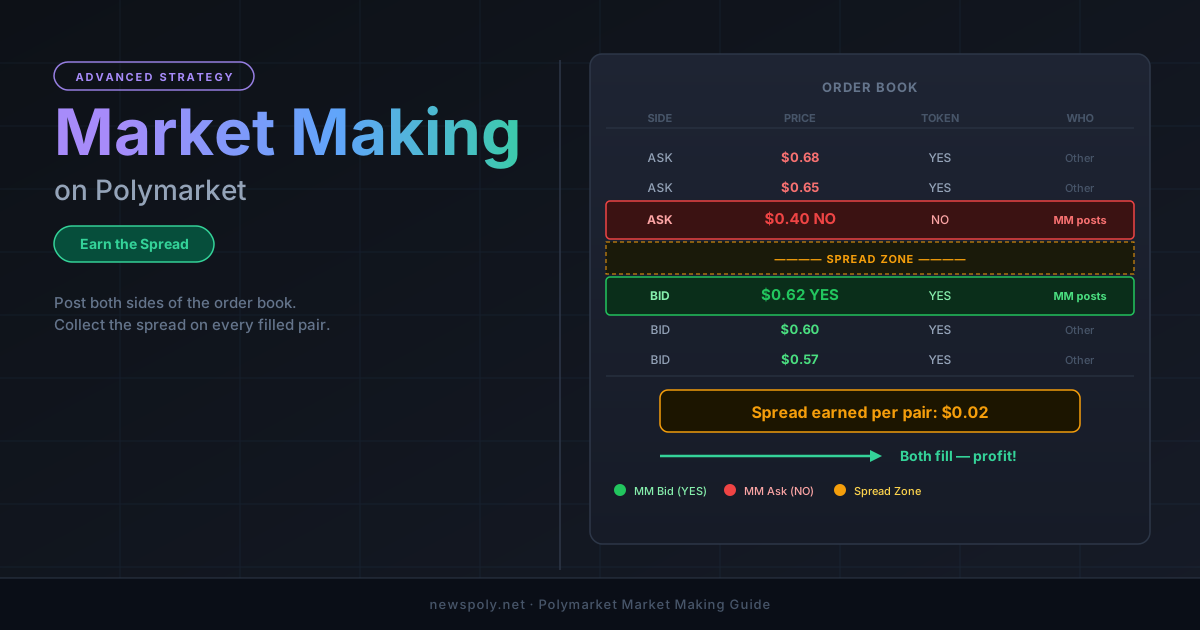
Most Polymarket participants focus on picking winners: research an event, decide whether YES or NO is underpriced, and place a directional bet. Market making takes the opposite approach. Instead of forming a view on the outcome, a market maker posts orders on both sides of the order book simultaneously and earns the difference between the buy price and the sell price on every completed pair of trades. It is a systematic, statistics-driven strategy that has nothing to do with predicting results and everything to do with providing a service that other traders need.
This guide explains exactly how market making works on Polymarket, what the risks are, how much capital you need to get started, and whether the returns are worth the complexity.
What Is a Market Maker?
A market maker is any participant who simultaneously posts a bid (an offer to buy at price X) and an ask (an offer to sell at price Y), where Y is higher than X. The gap between those two prices is the bid-ask spread, and that spread is the market maker's gross revenue per round-trip trade.
Traditional financial markets rely heavily on designated market makers who are contractually obligated to maintain continuous two-sided quotes. Polymarket operates differently: anyone can become a market maker by posting limit orders on both sides of a binary market. There is no application process, no designation, and no minimum size requirement. If you post resting orders that other traders fill, you are functioning as a market maker.
The essential value proposition: you are providing liquidity. Without market makers, a trader who wants to buy YES immediately would have to wait for a natural counterparty to appear. Market makers solve this problem by always standing ready to trade, and they charge the spread as compensation for that service.
How the CLOB Enables Market Making on Polymarket
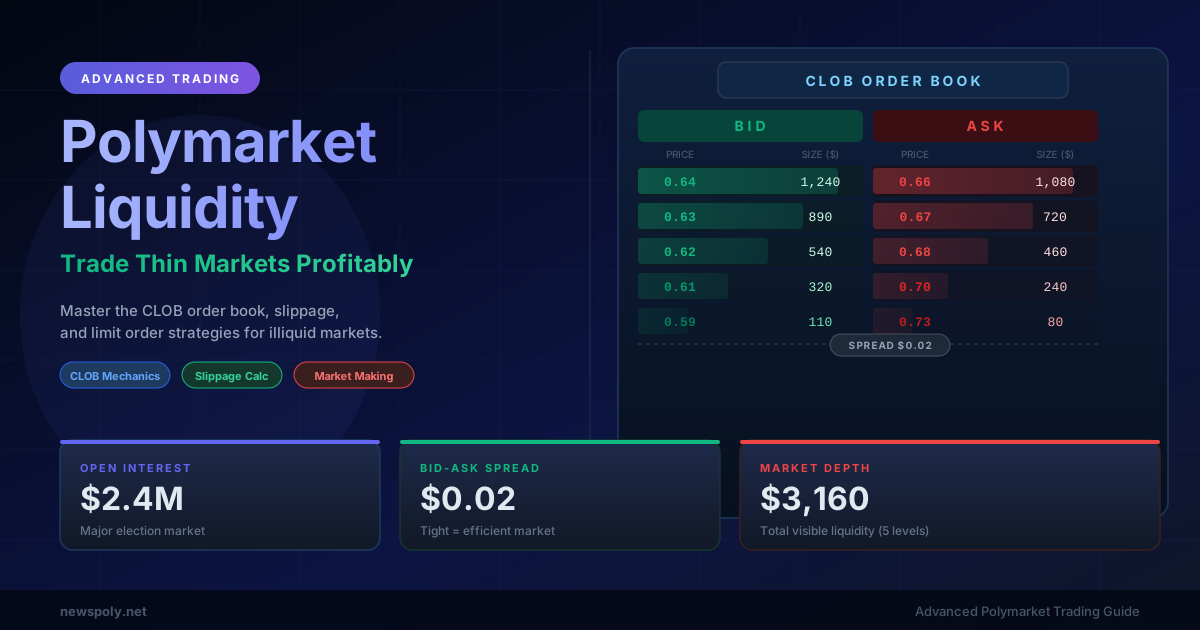
Polymarket uses a Central Limit Order Book, commonly called a CLOB. The CLOB and order book structure is what makes systematic market making possible. Every resting limit order is visible to all participants; trades execute when an incoming market order or marketable limit order matches a resting order at the best available price.
In a binary prediction market, every outcome token pair (YES + NO) sums to $1.00. This creates an important constraint for market makers: if you buy YES at $0.62, you have implicitly priced NO at $0.38. Quoting both sides of a binary market therefore means thinking about the probability space carefully. Your bid and ask must be positioned so that the spread is wide enough to cover fees and expected losses, but narrow enough that your orders actually get filled.
Polymarket's CLOB is non-custodial and on-chain (built on Polygon), so all order matching and settlement happens transparently. This matters for market makers because it eliminates counterparty risk with the exchange itself, though it introduces smart contract risk that directional traders share too.
A Basic Market Making Example
Here is a concrete example to make the mechanics tangible. Suppose a market is currently showing:
- Best bid for YES: $0.60
- Best ask for YES: $0.65
You decide to tighten the spread slightly and post:
- A YES bid at $0.62 (you offer to buy YES at 62 cents)
- A NO bid at $0.40 (equivalent to offering to sell YES at $0.60, or more precisely, buying NO at 40 cents which is selling YES at 60 cents)
Wait, how does the NO bid equate to a sell on the YES side? Because YES + NO = $1.00, buying NO at $0.40 is identical to selling YES at $0.60 from a P&L perspective. A trader who sells you YES at $0.62 and another who sells you NO at $0.40 have together transferred $1.02 worth of tokens to you for a combined cost of $1.02. But when the market resolves, one of those tokens will pay $1.00 and the other $0.00. You paid $1.02 total and receive exactly $1.00 at resolution, losing $0.02 per pair before fees.
That is not quite right as stated, so let's be precise about the fee structure. Polymarket charges a fee on each trade. If fees are 0% for makers (Polymarket has historically offered zero maker fees), then a successful round-trip looks like this:
- You buy YES at $0.62 from a seller
- You buy NO at $0.38 from a different seller (you set your NO bid at $0.38, not $0.40)
- Combined cost: $1.00 exactly
- One token resolves to $1.00, other to $0.00
- Net result: $0.00 gain, exactly break-even
For market making to be profitable, you need your YES bid below $0.50 and your NO bid below $0.50, with the sum of the two bids less than $1.00. The difference between $1.00 and your combined cost is your gross spread per pair. Example: YES bid at $0.62, NO bid at $0.36, combined cost = $0.98, gross spread = $0.02 per completed pair. After maker fees (if any), the net spread is your profit per cycle.
Market making requires capital and constant attention. PolyCopyTrade offers a simpler passive approach — automatically copy proven directional traders while they do the analysis.
Why Market Makers Matter
Before getting into the risks and returns, it is worth understanding why market making is genuinely useful. Without market makers:
- Spreads would be wide, making it expensive to enter or exit positions
- Thin markets would be highly sensitive to single large orders moving prices dramatically
- Casual traders who want quick execution would be forced to use market orders that eat into profits
- The overall ecosystem would attract fewer participants
Market makers are the infrastructure of a liquid market. They are compensated not for being right about outcomes, but for bearing the risk of holding inventory that the market did not immediately want. Understanding this distinction is key to understanding the specific risks you take on as a market maker.
Market Making Risk: Inventory Risk
The central risk of market making is inventory risk. This arises when only one side of your two-sided quote gets filled.
Imagine you post YES bid at $0.62 and NO bid at $0.36. A trader immediately buys all your YES offers (sells YES to you). You now hold a large YES position at $0.62 average cost with no corresponding NO hedge. If the true probability is actually lower than $0.62, you are holding an overpriced position. Every tick down is a loss.
Managing inventory risk is the core operational challenge of market making, and it sits within the broader framework of Polymarket risk management that every serious participant should have in place. Strategies to mitigate it include:
- Tightening or withdrawing quotes when one side fills rapidly (rapid fills often signal informed trading)
- Skewing quotes to make the filled side less attractive and the unfilled side more attractive, naturally rebalancing your book
- Position limits per market, so no single event can create catastrophic inventory exposure
- Diversifying across many markets so inventory imbalances in one market are offset by opposing imbalances elsewhere
New market makers frequently underestimate inventory risk because the spread looks like free money. It is not. The spread is compensation for the very real possibility that you end up holding a one-sided position in a market that moves against you.
Which Polymarket Markets Are Best for Market Making?
Not all markets on Polymarket are equally suitable for market making. You want to identify markets that sit in a specific middle zone:
Too illiquid (avoid): Markets with almost no volume have few counterparties. Your orders may sit unfilled for days, and when they do fill, it is likely because an informed trader has a strong directional view. The risk/reward is poor.
Too liquid (competitive): The highest-volume Polymarket markets (major election markets, prominent sports markets) attract sophisticated algorithmic market makers who quote extremely tight spreads. Your manual or semi-automated quotes will be undercut immediately. The spreads available to you are thin relative to the risks.
The sweet spot: Markets with moderate daily volume (roughly $5,000 to $50,000 per day), binary outcomes, meaningful time to resolution (weeks to months), and spreads that are currently 3-8 cents wide. These markets have enough flow to fill your quotes regularly but are not so competitive that you cannot earn a workable spread.
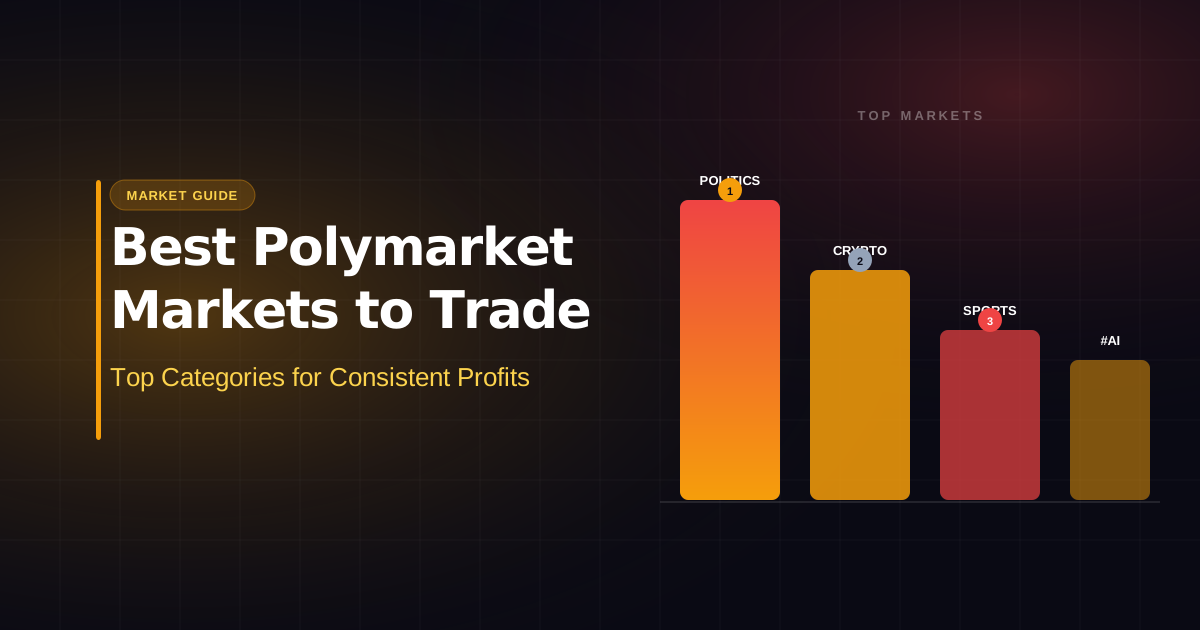
Practical categories that often fit this profile:
- Mid-tier geopolitical events with ongoing news flow
- Economic indicator markets (will the Fed cut rates this meeting?)
- Sports markets for games one to two weeks out
- Regulatory and legal outcome markets with slow-moving information
Avoid markets close to resolution. In the final hours before an event, prices move rapidly and your spread is much more likely to be eaten by a well-informed directional trader who knows more than you.
Automated Market Making vs Manual
Manual market making means logging into Polymarket, scanning order books, posting limit orders, and then returning regularly to adjust quotes as prices drift or inventory shifts. This is feasible for two or three markets if you have significant time available, but it does not scale.
Automated market making uses a script or bot that connects to Polymarket's API to:
- Monitor order books across many markets simultaneously
- Calculate fair value using a pricing model
- Automatically post, cancel, and replace limit orders to maintain target spread and position
- Manage inventory by skewing quotes when one side fills
- Respect position limits and pause quoting when uncertainty spikes
Polymarket provides a public REST API and WebSocket feed that developers can use to build these systems. The technical barrier is real: you need to understand the API, handle authentication, manage wallet interactions, and write robust error handling. But for anyone who can code at an intermediate level, the tooling is accessible. Our Polymarket API and on-chain data guide covers the REST API endpoints, WebSocket feeds, and Polygon data sources you will need to get started.
Even a simple automated market making system that quotes five to ten markets with basic inventory skewing logic will dramatically outperform manual market making in both scale and consistency.
How Much Capital Do You Need?
There is no minimum, but practical reality sets a floor. Consider a single market where you want to post $100 on each side (YES bid and NO bid). That is $200 deployed in one market. If you are tracking ten markets, you need $2,000 minimum, plus a buffer for inventory imbalances that lock up capital temporarily.
A reasonable starting point for manual market making across three to five markets is $500 to $1,500. For automated market making across ten to thirty markets, $5,000 to $20,000 allows meaningful position sizes without the per-trade economics being destroyed by minimum gas fees on Polygon (which are minimal anyway).
Unlike directional trading where you can start small and scale up based on conviction, market making benefits from scale because the percentage return on spread is fixed but the absolute dollar return scales with capital deployed. The expected value per trade is small; volume is what makes it add up.
Risks: Adverse Selection, Resolution Risk, and Liquidity Withdrawal
Beyond inventory risk, market makers on Polymarket face three additional risks worth understanding explicitly.
Adverse selection is the most important. When an informed trader has high-confidence information that you do not have, they will pick off your quotes before you can adjust. You sell YES at $0.62 to someone who knows the outcome is very likely YES at $0.85. Your quote gets filled precisely because it was mispriced. This is the classic market maker's problem: random uninformed traders fill your quotes at a rate that generates small profits, but the rare informed trader fills your quotes and generates a large loss that wipes out many small wins.
Protecting against adverse selection means:
- Widening spreads around scheduled news events (announcements, votes, results)
- Reducing size or withdrawing quotes when volume spikes abnormally
- Avoiding markets with imminent resolution
- Watching for order flow patterns that suggest informed activity
Resolution risk is the possibility that a market resolves in a way that leaves you with inventory on the losing side. If you are holding $800 worth of YES tokens when a market resolves NO, those tokens are worth zero. This is not the same as adverse selection, but it can be just as damaging. It is why position limits and diversification are non-negotiable.
Liquidity withdrawal risk is when you need to exit a position but cannot find counterparties. In normal operation, you would simply cancel your resting orders and wait for inventory to drain naturally as offsetting orders fill. But in a fast-moving market, the spread widens, other market makers withdraw, and you may be forced to cross the spread at an unfavorable price to reduce risk. This is most acute near resolution.
Expected Returns from Market Making
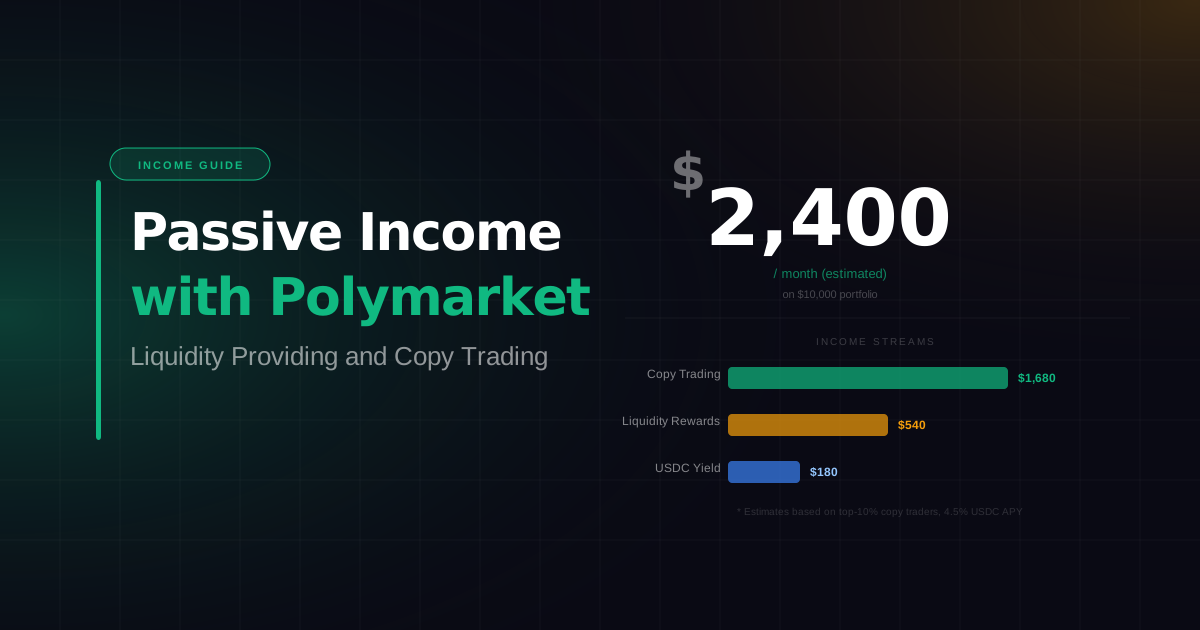
Realistic return expectations for market making on Polymarket depend heavily on execution quality, market selection, and automation. Based on the structure of available spreads and typical fill rates, rough benchmarks are:
- Manual market making, 3-5 markets: 0.5% to 2% per month on deployed capital, before accounting for adverse selection losses
- Automated market making, 10-30 markets: 2% to 6% per month on deployed capital for well-tuned systems, with meaningful variance
- Professional-grade systems: Higher, but these participants are also pushing spreads tighter for everyone else
These returns are not guaranteed. A single adverse selection event or a poorly managed inventory position can erase weeks of spread income. The Sharpe ratio of market making (return per unit of risk) tends to be reasonable but not exceptional, and it degrades as you scale up because larger quotes are more visible targets for informed traders.
How Professional Market Makers Operate on Polymarket
Professional market makers on Polymarket are typically small trading firms or sophisticated individuals running automated systems. Their edge comes from several sources:
Better pricing models: Instead of quoting around the last traded price, professionals use probabilistic models that incorporate external information (news sentiment, related market prices, historical base rates) to estimate fair value more accurately than the displayed order book. Their quotes are positioned more defensively relative to their true estimate of the probability.
Cross-market hedging: A professional quoting a political market might hold offsetting positions in correlated markets or use external prediction markets to hedge residual exposure. This reduces net inventory risk even when individual markets move against them.
Speed and cancellation logic: When relevant news breaks, professional systems cancel stale quotes within milliseconds before they can be hit by faster traders updating their directional positions. Stale quote management is a significant source of P&L leakage for slower participants.
Volume-based fee optimization: At sufficient volume, fee structures often improve. Professionals are constantly optimizing around fee tiers, minimum order sizes, and gas cost efficiency on Polygon to squeeze additional basis points out of each trade.
If you are competing directly with professional systems on high-volume markets, you will generally lose. The opportunity for retail market makers lies in markets that are too small or obscure to attract professional attention, where spreads are wider and fill rates are sufficient to generate reasonable returns without needing to win a speed competition. Market making is one of several approaches covered in the top Polymarket trading strategies guide, which is useful context for deciding where market making fits in your overall approach.
Market making requires capital and constant attention. PolyCopyTrade offers a simpler passive approach — automatically copy proven directional traders while they do the analysis.
Frequently Asked Questions
Do I need to predict outcomes to make money as a market maker?
No. Market making is specifically designed to be outcome-agnostic. You profit from the spread between your buy and sell prices regardless of which side resolves YES or NO, as long as both sides of your quote get filled before resolution. That said, you still need to manage inventory risk, which requires some awareness of market conditions and information flow that could move prices against your resting orders.
What happens if a market resolves with me holding one-sided inventory?
If you are holding YES tokens when the market resolves NO, those tokens become worthless and you lose the full amount invested in that position. This is why position limits are essential. A typical risk management approach caps any single market exposure at 5-10% of total deployed capital, so even a complete loss on one position is a manageable setback rather than a catastrophic one.
Can I do market making on Polymarket without writing code?
Yes, but with significant limitations. Manual market making works by placing limit orders through the Polymarket interface, monitoring fills, and adjusting quotes regularly. You can do this for one or two markets without automation. Beyond that, the overhead of monitoring and updating dozens of resting orders becomes impractical. Most market makers who treat it seriously eventually automate at least the order management and quote adjustment logic, even if their pricing model remains simple.
Market making requires capital and constant attention. PolyCopyTrade offers a simpler passive approach — automatically copy proven directional traders while they do the analysis.