Polymarket and Metaculus are two of the most respected forecasting platforms on the internet — and in almost every important way, they are opposites. One settles predictions with real USDC on a blockchain; the other runs entirely on reputation and intellectual rigor. Both attract elite forecasters. Both beat mainstream media on accuracy. Yet they serve fundamentally different purposes, and choosing between them — or knowing when to use both — can meaningfully sharpen how you think about uncertain events.
Quick Comparison: Polymarket vs Metaculus
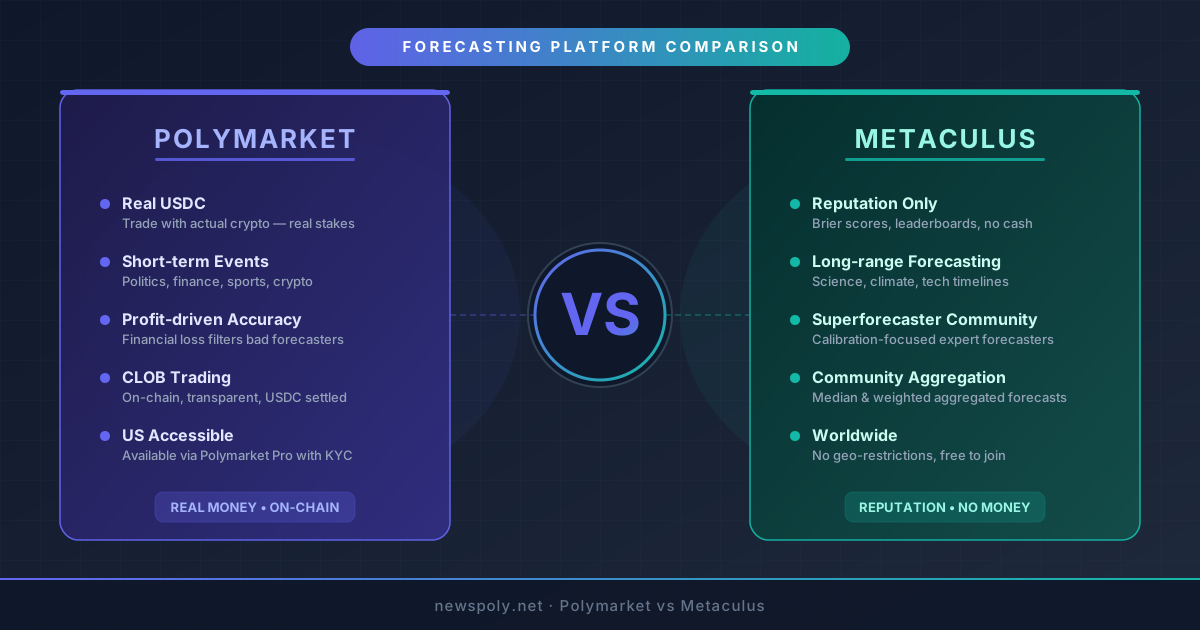
| Feature | Polymarket | Metaculus |
|---|---|---|
| Real Money | Yes — USDC (crypto) | No — reputation points only |
| KYC Required | Yes (for US users via Polymarket Pro) | No |
| Market Types | Politics, finance, sports, crypto, current events | Science, geopolitics, technology, long-range societal questions |
| Accuracy Incentive | Direct profit/loss in USDC | Brier score, leaderboard ranking, occasional prize money |
| Geo Access | Restricted in some jurisdictions | Worldwide, no restrictions |
| Best Use Case | Trading near-term events; real-money profit | Deep research; long-range probability estimates |
What Is Metaculus?
Metaculus is a community forecasting platform founded in 2015. It aggregates probability estimates from thousands of registered forecasters and tracks each user's historical Brier score — a mathematical measure of calibration that penalises both overconfidence and underconfidence. Users who consistently make well-calibrated predictions rise to the top of the leaderboards and earn the informal status of "superforecaster."
There is no real money involved. Forecasters are rewarded with reputation, community recognition, and occasionally small cash prizes from tournaments run by organisations like ACX Forecasting (Astral Codex Ten). The lack of financial stakes is both Metaculus's greatest limitation and one of its unique strengths: it removes short-term profit motives and allows forecasters to focus on genuinely hard, long-range questions that no prediction market would ever list — like "Will the global average temperature anomaly exceed 1.5°C by 2035?" or "Will a fusion power plant supply electricity to a national grid before 2040?"
Metaculus questions are often open for years, sometimes decades. The platform publicly archives every forecast with timestamps, making it one of the most valuable long-run calibration datasets in existence. It is entirely free to use.
What Is Polymarket?
Polymarket is a decentralised prediction market built on the Polygon blockchain. Users deposit USDC and trade binary outcome contracts — buying shares in "Yes" or "No" on a given question. Prices fluctuate between $0.00 and $1.00, and each price represents the market's implied probability. A contract at $0.72 means the crowd collectively prices the event at a 72% chance of occurring.
Polymarket uses a Central Limit Order Book (CLOB), which means prices are set by supply and demand between real traders, not by an automated market maker. When the event resolves, winning shares pay out $1.00 each in USDC; losing shares pay nothing. Everything is on-chain and publicly verifiable.
For a full breakdown of how the platform works, see our Polymarket review. If you are new to interpreting contract prices, our guide on reading odds is a good starting point.
Use Metaculus for research, Polymarket for profit. PolyCopyTrade automatically trades Polymarket on your behalf — letting you focus on the forecasting research while execution is handled.
The Incentive Question: Does Real Money Improve Accuracy?
This is the crux of the debate. Metaculus defenders argue that intellectual reputation is sufficient motivation for careful thinking. Polymarket defenders argue that nothing concentrates the mind like actual money on the line.
The empirical research generally supports the skin-in-the-game view. A widely cited 2022 paper by Karger et al. compared prediction market prices to aggregated survey forecasts across a large set of matched questions and found that markets consistently outperformed surveys — even when the survey respondents were highly informed. The mechanism is straightforward: a trader who is wrong repeatedly loses money and exits the market. A survey respondent who is wrong repeatedly loses nothing and keeps participating. Markets are, in effect, a continuous selection filter for well-calibrated views.
Philip Tetlock's original superforecaster research (the basis for Good Judgment Project) showed that skilled individuals can match or beat prediction markets over short horizons — but Tetlock himself has noted that financial markets with large, liquid participation tend to be harder to beat than human aggregates over time. Polymarket's liquidity on major political and financial events is now substantial enough that this dynamic applies.
The nuance: for obscure, long-range, or scientific questions where Polymarket has no market — and where financial incentives would attract uninformed noise traders — Metaculus's curated community of careful forecasters may actually produce better-calibrated estimates. Real money helps accuracy, but only when the participants are informed. On niche topics, Metaculus's self-selected expert community can outperform a thin, speculative prediction market.
Which Platform Is More Accurate?
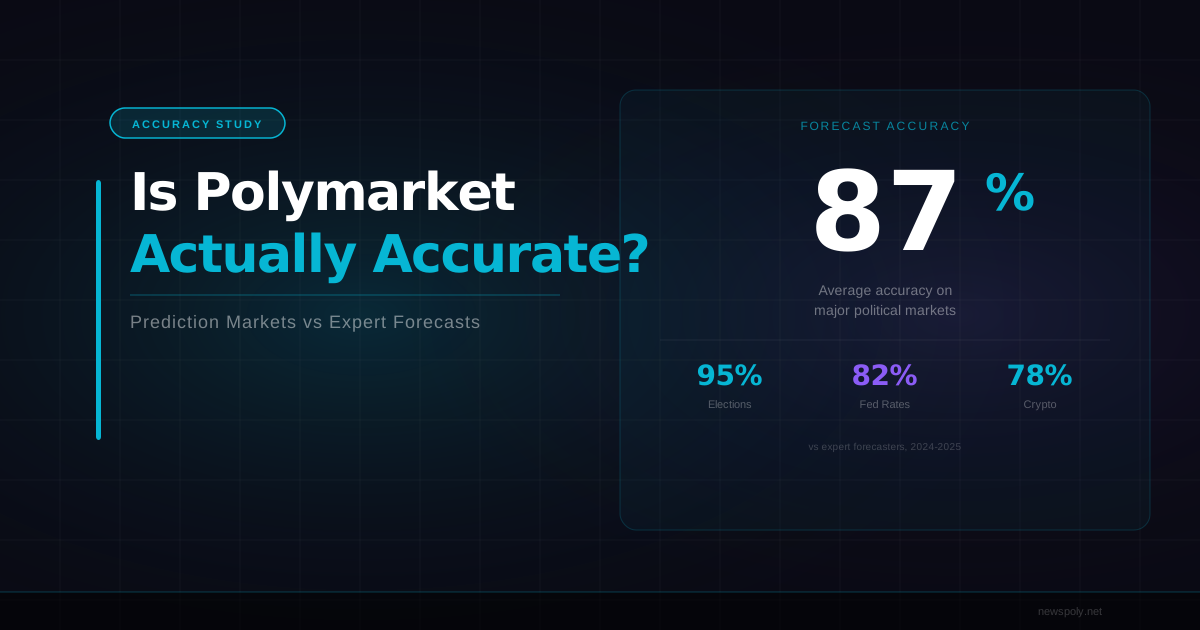
For near-term political and financial events where both platforms have coverage, the evidence tilts toward Polymarket. Its prices incorporate large amounts of capital from informed, profit-motivated traders and have demonstrated strong calibration on US elections, Fed decisions, and major geopolitical events. The 2024 US presidential election was perhaps the most-cited example: Polymarket's markets correctly assigned Donald Trump a roughly 60–65% probability weeks before polls showed similar numbers, while many media outlets characterised the race as a coin flip.
Metaculus, meanwhile, excels on questions that require deep domain expertise, long time horizons, or multi-year tracking. Its community of superforecasters regularly out-performs journalistic consensus on scientific and technological milestones. For questions like "Will GPT-5 be released before January 2026?" or long-range climate benchmarks, Metaculus's aggregated forecasts are among the most reliable publicly available estimates. When you do trade on Polymarket, applying a rigorous expected value calculation before every position ensures you only enter trades where your probability estimate has a genuine edge over the market price.
The honest answer: neither platform is universally more accurate. Polymarket wins on near-term, high-liquidity events. Metaculus wins on long-range, low-liquidity, or scientific questions. For serious forecasting work, you should consult both.
Market Coverage Comparison
Polymarket lists several hundred active markets at any given time, concentrated in:
- US and global politics (elections, legislation, geopolitical events)
- Financial markets (Fed rate decisions, crypto prices, ETF approvals)
- Sports (major tournaments, championship outcomes)
- Technology (AI model releases, company milestones)
- Current events (breaking news outcomes)
Most Polymarket markets resolve within weeks to a few months. Very few extend beyond one year.
Metaculus hosts over 20,000 questions, many of which remain open for years. Coverage includes:
- AI and technology development timelines
- Climate science and environmental benchmarks
- Geopolitical conflict and treaty outcomes
- Public health (pandemic, disease burden)
- Science (physics milestones, space exploration)
- Economics and social trends over multi-year horizons
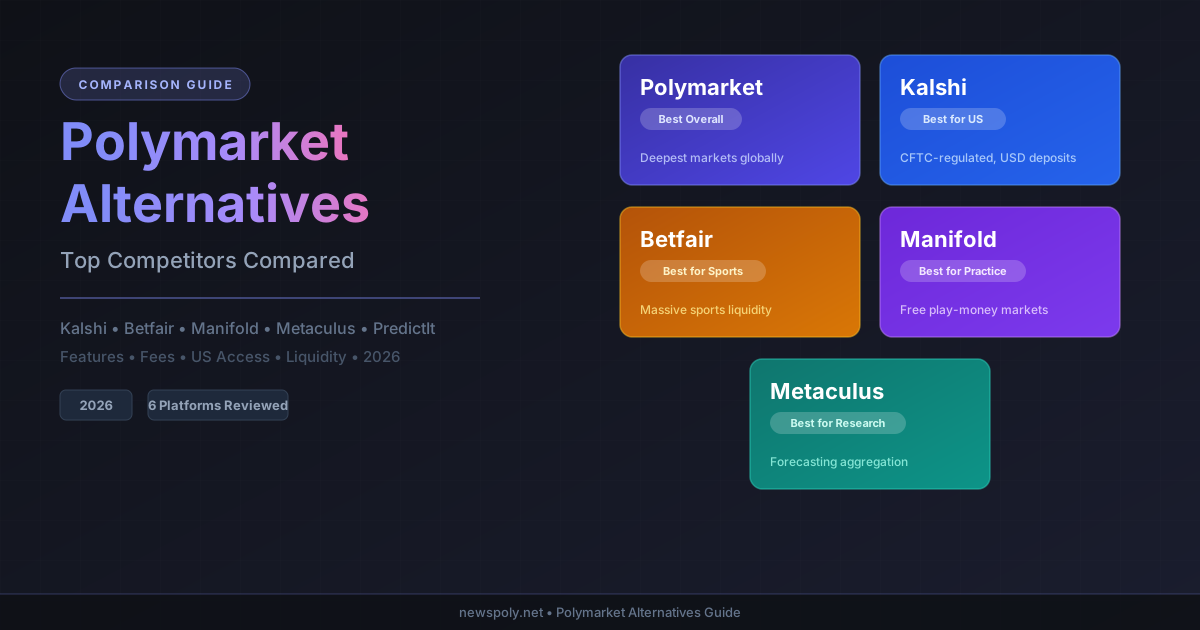
If you are researching a question that Polymarket does not cover — or where Polymarket's market is too thinly traded to be reliable — Metaculus is often the best free alternative. Our roundup of prediction market alternatives covers additional platforms worth consulting.
Superforecasters vs Profit-Seekers
The communities on each platform are meaningfully different in culture and motivation.
Metaculus attracts forecasters who derive intrinsic satisfaction from being well-calibrated. Many are academics, researchers, rationalists, and effective altruists who treat forecasting as an intellectual discipline. The platform explicitly celebrates Brier score improvement as a form of mastery. Community commentary on questions is often detailed, citing academic papers and domain expertise. The goal is epistemic accuracy.
Polymarket attracts traders. Some are sophisticated quants and data scientists who build probabilistic models; others are political junkies who follow news flow; others are arbitrageurs who exploit inefficiencies between Polymarket, Kalshi, and other prediction markets. The goal is profit. This is not a criticism — profit-seeking produces accurate prices because it punishes error with financial loss. But the community dynamic is different: less collaborative commentary, more competitive positioning.
For calibration purposes, reading Metaculus community comments before taking a position on a related Polymarket question is a powerful combination. Metaculus produces the careful analysis; Polymarket provides the execution venue.
Using Both Together
The most sophisticated approach is to treat Metaculus and Polymarket as complementary tools rather than competitors.
Metaculus as research infrastructure. Before trading a Polymarket question, search Metaculus for related questions. If Metaculus's aggregated community forecast on a closely related topic is substantially different from the Polymarket price, that divergence is worth investigating. Either Metaculus's long-run forecasters are missing short-run information (Polymarket is probably right), or Polymarket traders are underweighting expert opinion (Metaculus may be offering the edge).
Polymarket for execution. Once you have formed a well-researched view using Metaculus commentary, academic forecasts, and your own analysis, Polymarket is where you put money behind that view. The CLOB structure means you get fair prices, transparent on-chain settlement, and USDC payouts.
This research-then-execute workflow is exactly how serious forecasters operate. See also our Manifold comparison for another angle on play-money vs real-money forecasting dynamics.
Already doing the research but struggling with execution? PolyCopyTrade mirrors the trades of proven Polymarket forecasters directly to your account — so your capital benefits from top-tier analysis without requiring you to monitor markets around the clock.
Can You Make Money on Metaculus?
In the traditional sense, no. There is no mechanism to withdraw USDC or cash from Metaculus based on your forecasting performance. Your reward is a high Brier score, leaderboard placement, and community reputation.
Occasionally, Metaculus runs or hosts prize tournaments — some sponsored by foundations, think-tanks, or aligned organisations like Open Philanthropy or the Future of Humanity Institute — where top forecasters receive modest cash prizes, sometimes in the $500–$5,000 range. ACX Forecasting (Scott Alexander's annual forecasting competition) also pays out small prizes to top performers.
For those who want to monetise forecasting skill, Polymarket is the obvious path. Metaculus is where you build and validate that skill cheaply, with no financial risk.
Who Should Use Which?
Use Metaculus if:
- You want to improve your forecasting calibration without financial risk
- You are researching long-range or scientific questions
- You want access to expert community commentary and detailed probability tracking
- You are outside Polymarket's supported jurisdictions
- You want a free platform with no crypto wallet required
Use Polymarket if:
- You want to profit from accurate probability estimates
- You are focused on near-term political, financial, or current events
- You want transparent, on-chain settlement in USDC
- You are comfortable with crypto wallets and DeFi infrastructure
- You want real-money skin in the game to sharpen your thinking
Use both if: you take forecasting seriously as a discipline and want to combine rigorous long-range research with near-term profit opportunities. This is the approach used by the most sophisticated participants in both communities.
New to Polymarket and not sure where to start? Our Polymarket beginner guide covers wallet setup, depositing USDC, and placing your first trades — or PolyCopyTrade gives you instant exposure to Polymarket's best-performing traders, an easy on-ramp that lets you learn how the markets work while your capital is already working for you.
Frequently Asked Questions
Is Polymarket more accurate than Metaculus?
For near-term, high-liquidity events — US elections, Fed rate decisions, major sports outcomes — Polymarket generally demonstrates marginally better accuracy due to financial incentives filtering out poorly-calibrated traders. For long-range, scientific, or low-liquidity questions, Metaculus's expert community often produces equally or more accurate probability estimates. Neither platform dominates across all question types.
Can I use Metaculus to find edges on Polymarket?
Yes, and this is one of the most underutilised strategies in prediction markets. When Metaculus's aggregated community forecast on a related question differs significantly from a Polymarket price, that gap often signals an opportunity. Metaculus commentary frequently surfaces expert domain knowledge that Polymarket's trader community has not fully priced in, particularly on scientific and geopolitical questions.
Does Metaculus require a crypto wallet?
No. Metaculus is a traditional web application with email-based registration. No cryptocurrency, wallet, or blockchain interaction is required. This makes it fully accessible worldwide without the technical friction of Polymarket's USDC-based system, where users must manage a wallet on the Polygon network.