Two platforms dominate the conversation when people discover prediction markets for the first time: Polymarket and Manifold Markets. They share a common premise — let users trade on the probability of real-world events — but underneath that surface similarity they are almost entirely different products. One is a high-stakes, high-liquidity exchange where serious forecasters and traders move real money. The other is a free-to-play community platform where anyone can spin up a market in seconds. Knowing which one belongs in your toolkit requires understanding exactly where those differences lie.
Key Differences at a Glance
Before diving into each dimension, here is a side-by-side summary of the most important distinctions between Polymarket and Manifold Markets.
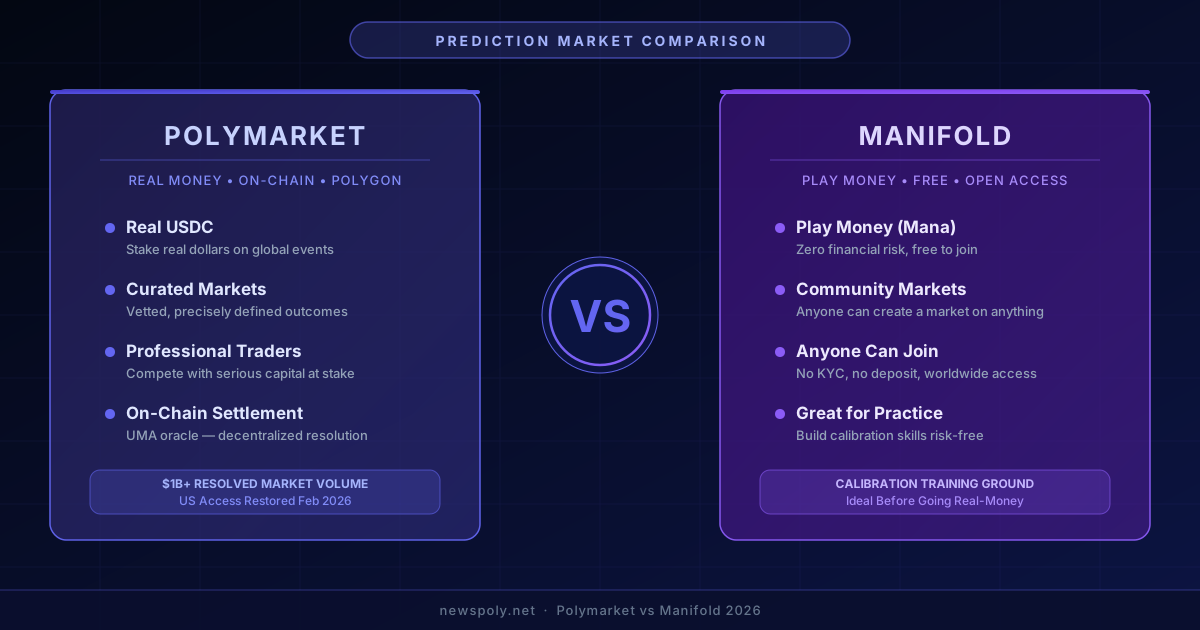
| Feature | Polymarket | Manifold Markets |
|---|---|---|
| Currency | USDC (real money) | Mana (play money, no cash value) |
| Real-Money Trading | Yes | No (Mana only) |
| Market Creation | Curated (team-approved) | Open (any user) |
| Liquidity | Billions in cumulative volume | Very low (play-money pools) |
| Platform Type | Decentralized (Polygon blockchain) | Centralized web app |
| Fees | 2% on winnings | None (play money) |
| US Availability | Restricted | Available |
| Copy Trading | Yes (via PolyCopyTrade) | No |
| Market Count | Thousands (curated, high-volume) | Hundreds of thousands (user-generated) |
| Resolution Mechanism | UMA oracle protocol | Market creator or admin |
Real Money vs Play Money: The Fundamental Divide
This is the most consequential difference between the two platforms, and it shapes everything else. Polymarket uses USDC — a USD-pegged stablecoin — as its trading currency. Every position you open, every share you hold, every profit you take has real dollar value. When you see a market pricing an event at 62 cents, you are looking at a price set by traders who have staked actual money on their beliefs.
Manifold Markets uses Mana, a proprietary play-money currency with no cash value. You receive free Mana when you sign up, earn more through streaks and bonuses, and spend it trading on markets. There is no way to withdraw Mana as real money. Manifold does offer a charitable donation feature — you can convert Mana into donations to vetted nonprofits at a fixed rate — but that is a fundamentally different proposition from earning tradable profits.
Why does this matter? Because financial incentives drive forecast quality. When traders have real money on the line, they research carefully, update positions quickly when new information arrives, and arbitrage away mispricings. The result is a market that genuinely reflects the collective knowledge of its participants. Mana-denominated markets can still produce useful forecasts, and Manifold has built a dedicated forecasting community, but the incentive structure simply cannot replicate what real-money stakes produce.
Market Types and Depth
Polymarket focuses on a curated set of high-signal markets: politics, economics, sports, geopolitics, science, and technology. The curation is intentional — each market goes through an approval process to ensure clear, unambiguous resolution criteria. When you see a Polymarket market asking “Will the Fed cut rates in June 2026?” you can be confident the resolution terms have been carefully drafted. This matters enormously for traders who need to know exactly what they are betting on.
Manifold takes the opposite approach. Any registered user can create a market on any topic in seconds. The result is an enormous and eclectic catalog — hundreds of thousands of markets ranging from global geopolitical events to hyperspecific personal bets and pop-culture questions. This open-creation model produces extraordinary variety but also significant noise. Market quality varies wildly depending on whether the creator drafted clear resolution criteria. Markets can sit unresolved for months if the creator goes inactive.
For serious forecasting on consequential topics, Polymarket’s curated depth beats Manifold’s breadth. For obscure niche topics or community-driven speculation, Manifold’s open model has no peer.
Liquidity Comparison
Liquidity is where the gap between the two platforms becomes stark. Polymarket has processed billions of dollars in cumulative trading volume. Major markets — US elections, central bank decisions, major sporting events — routinely accumulate millions of dollars in open interest. Tight bid-ask spreads and large order books mean you can enter and exit positions of meaningful size without moving the market against yourself.
Manifold operates on a constant-product automated market maker (AMM) model, but the pools are funded with Mana that has no real economic value. Even the most popular Manifold markets rarely see position sizes that would be meaningful in real-money terms. This creates a practical problem for anyone trying to use Manifold prices as genuine forecasts: low liquidity makes prices more volatile and more easily influenced by a single trader’s activity.
For traders who want to act on their predictions at scale, Polymarket’s liquidity is a non-negotiable advantage. Our dedicated Polymarket liquidity guide explains how to read order books and choose markets with the depth you need.
User Base and Community
Manifold has cultivated a genuinely impressive forecasting community. Many of its most active users are also active on forecasting platforms like Metaculus. The platform hosts calibration tournaments, encourages epistemic norms, and attracts users who are genuinely interested in the craft of forecasting rather than purely financial gain. If your goal is to improve your forecasting accuracy in a low-stakes environment, Manifold’s community is a genuine asset.
Polymarket’s user base is more financially motivated. Its community includes professional traders, quantitative analysts, crypto-native speculators, and a growing cohort of forecasting enthusiasts who treat prediction markets as a serious investment vehicle. The platform gained enormous mainstream attention during the 2024 US election cycle, when its markets consistently outperformed polling aggregators in predictive accuracy. That track record has attracted serious capital and serious traders.
For a detailed look at how Polymarket performs against other forecasting benchmarks, see our analysis of whether Polymarket is actually accurate.
Fees Structure
Manifold is entirely free to use. There are no trading fees because there is no real money changing hands. You can create markets, trade freely, and build up your Mana balance without paying a cent. This zero-friction model is a big part of why Manifold has attracted such a large community of casual forecasters.
Polymarket charges a 2% fee on winnings. There are no deposit or withdrawal fees beyond standard blockchain gas costs on the Polygon network, which are typically negligible. The 2% fee is taken at resolution — you only pay when you win. For traders running large positions in highly liquid markets, this is a very competitive fee structure compared to traditional sports betting or financial derivatives.
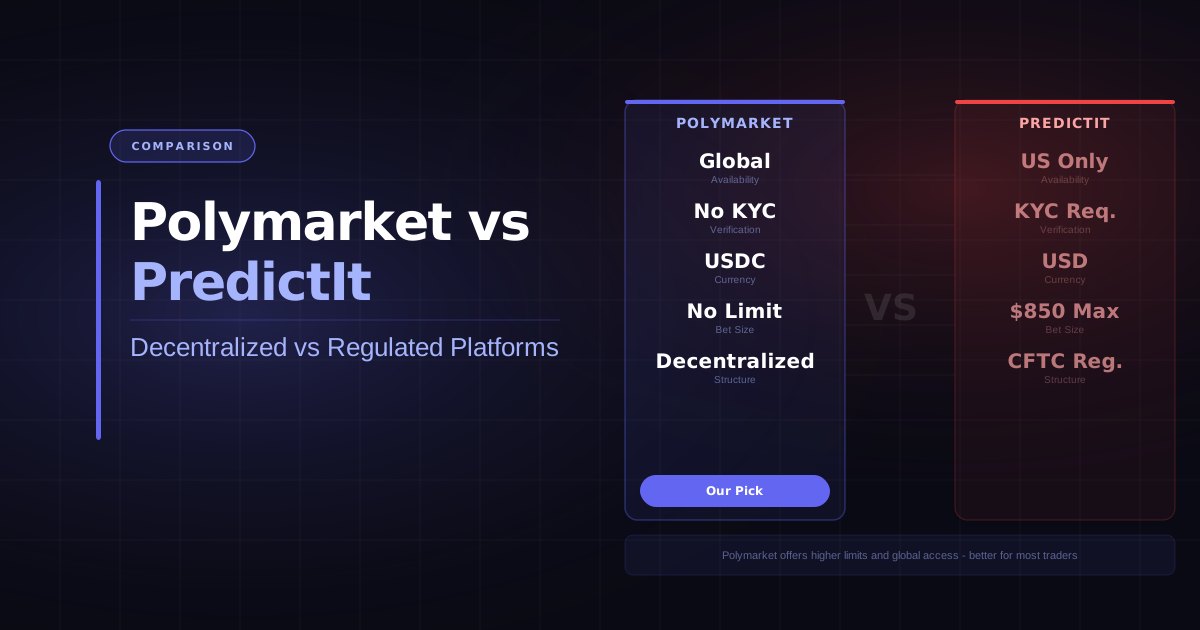
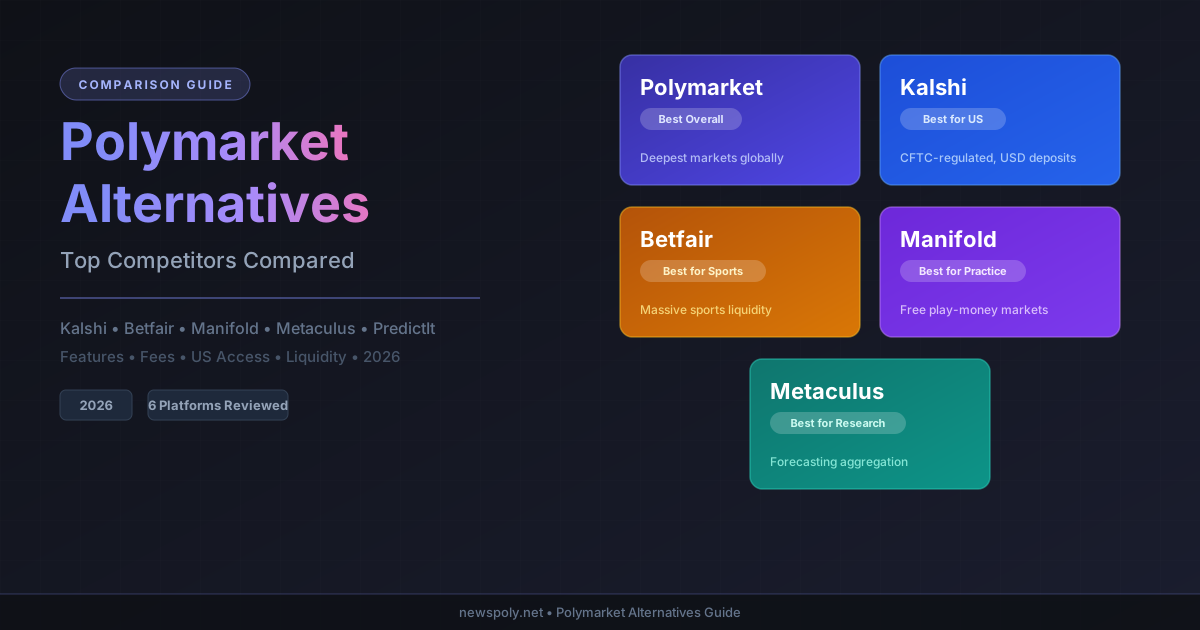
The fee comparison only matters if you are weighing real financial costs. For Manifold, fees are irrelevant because there are no real stakes. When you compare Polymarket’s 2% to traditional betting platforms or to Kalshi’s fee structure, it holds up well — our Polymarket vs Kalshi comparison goes deeper on this point.
Market Creation: Open vs Curated
Manifold’s open market creation is one of its defining strengths. Any user can create a binary (yes/no), multiple-choice, numeric, or date-based market within minutes. There is no approval gate, no minimum liquidity requirement, and no restrictions on topic. This has produced a remarkable archive of community forecasts on everything from geopolitical scenarios to celebrity gossip.
Polymarket’s market creation is tightly controlled. Only the Polymarket team can approve new markets, and they vet each one for clear resolution criteria, sufficient audience interest, and unambiguous outcome definitions. This is a deliberate choice — badly designed markets with ambiguous resolution criteria are the single biggest trust-destroyer in prediction markets, and curation helps avoid them.
The trade-off: Polymarket won’t have a market on every topic you care about. But every market it does have will be reliable. For traders who want to put real money to work, that reliability is worth the narrower selection.
Accuracy and Calibration
Both platforms have been studied for forecast accuracy, and both perform better than chance — but the comparison is not straightforward because they operate on different incentive structures.
Polymarket’s real-money markets have a strong empirical record. Independent analyses of the 2024 US election showed Polymarket prices converging on the correct outcome days before major polling aggregators. The financial incentives ensure that knowledgeable traders are constantly working to correct mispricings, which keeps probabilities well-calibrated on high-volume markets.
Manifold has run formal calibration studies on its platform and found that its community’s forecasts are meaningfully better-calibrated than naive base rates. The platform actively encourages calibration training and publishes calibration scores for top forecasters. For low-stakes personal forecasting and skill development, it performs admirably.
The honest assessment: on any given consequential question, a Polymarket price backed by millions of dollars is a more reliable signal than a Manifold price backed by free Mana. This is not a criticism of Manifold’s community — it is simply a function of how financial incentives sharpen forecasting. Also see our comparison with Polymarket vs Betfair for another angle on prediction market accuracy across platforms.
Who Should Use Which Platform?
The answer depends almost entirely on what you want out of a prediction market platform.
Choose Manifold Markets if:
- You want to practice forecasting without risking real money
- You are interested in niche or obscure topics not covered by major platforms
- You want to create your own markets without any approval process
- You are in the US and want access to a wide range of prediction markets
- You are building forecasting skills and want a low-stakes environment
Choose Polymarket if:
- You want to trade for real profits on real-world outcomes
- You need deep liquidity to enter and exit large positions
- You want reliable, well-curated markets with unambiguous resolution criteria
- You are outside the US and looking for the world’s largest prediction market
- You want access to copy trading tools that let you mirror expert forecasters
These two use cases are not mutually exclusive. Many serious Polymarket traders also use Manifold for research, calibration practice, or to track community sentiment on markets not yet listed on Polymarket. But when it comes to putting real capital to work, Polymarket is in a different league.
Why Serious Traders Choose Polymarket
The case for Polymarket among serious traders comes down to four words: real money, real liquidity. When you identify a market mispricing on Polymarket — a political event priced too low, an economic outcome the market has underweighted — you can act on that insight with meaningful capital and realize a meaningful profit. The same insight on Manifold earns you Mana that cannot be withdrawn.
Polymarket’s blockchain architecture also provides a level of transparency and self-custody that centralized platforms cannot match. Your USDC stays in your wallet; the smart contracts execute automatically at resolution; there is no platform counterparty risk. For traders who take security seriously, this matters. New to the platform entirely? Our Polymarket beginner guide walks through wallet setup, depositing USDC, and placing your first trade step by step. Our comprehensive Polymarket review covers the full technical and trading picture for returning readers.
The platform’s growth trajectory reinforces the choice. Polymarket has gone from a niche crypto project to a mainstream media fixture cited by Reuters, Bloomberg, and major political analysts. The network effects of a large, financially motivated user base compound over time — more traders mean tighter spreads, more markets, and more reliable prices. That flywheel is only accelerating in 2026.
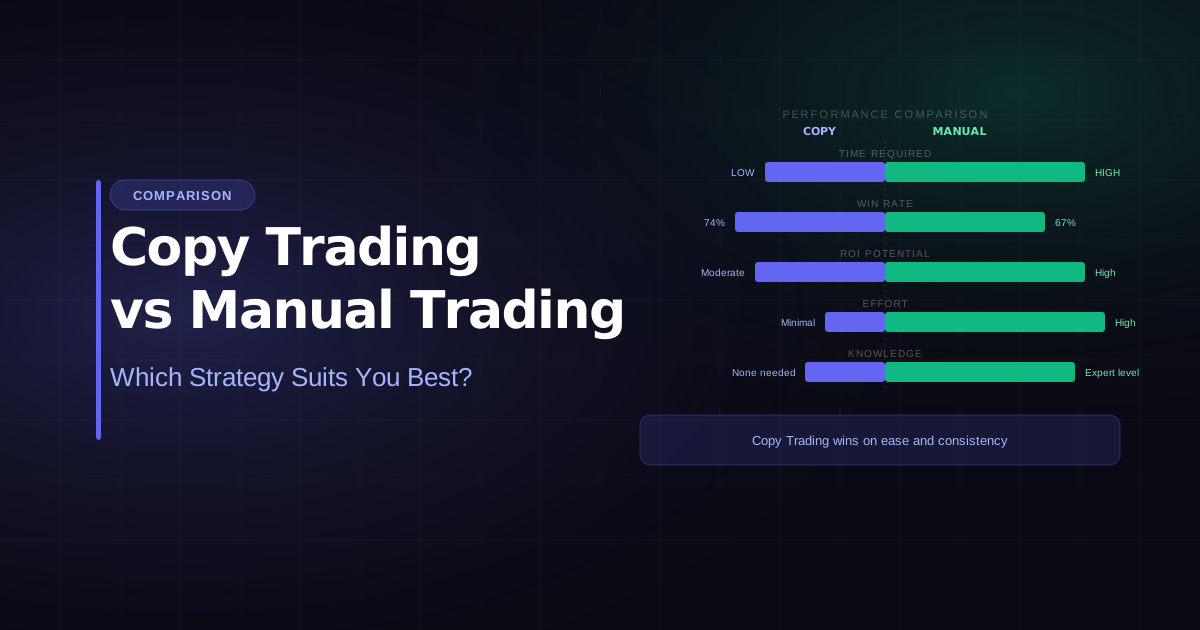
For traders who want to participate in Polymarket’s ecosystem without spending hours on research and position management, copy trading is the most efficient path. Rather than building expertise from scratch, you mirror the positions of top-ranked forecasters who have already done the analytical work. It is the same principle that made copy trading popular in forex and crypto — applied to the world’s most accurate prediction market. For a breakdown of exactly how copy trading compares to trading independently, see our copy trading vs manual trading guide.