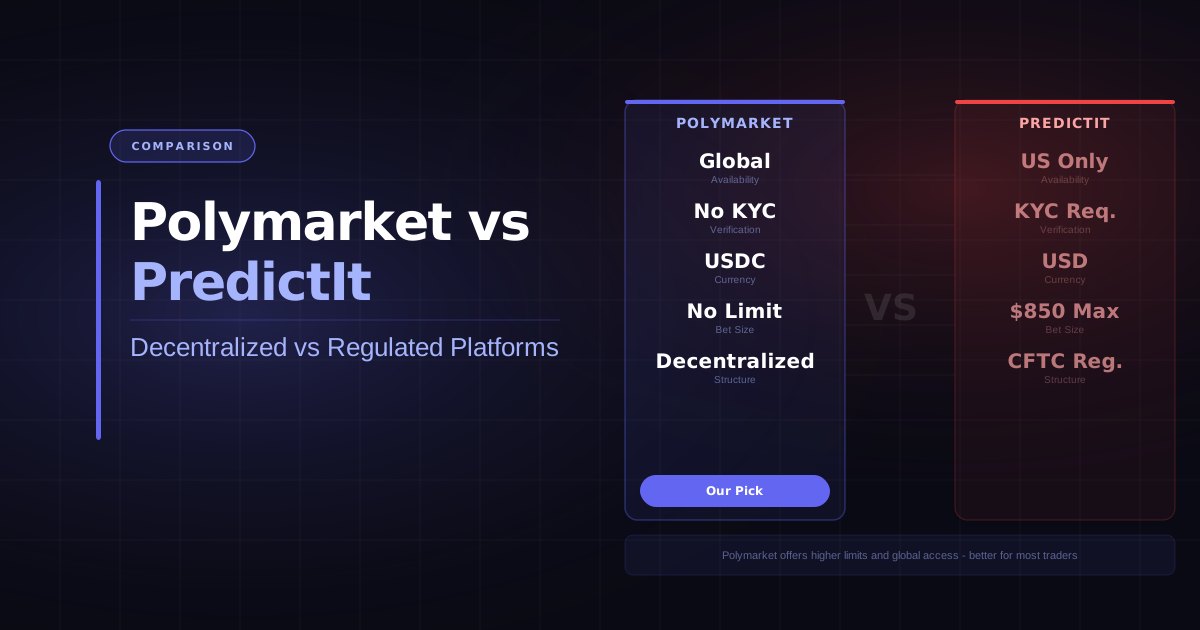
Both Polymarket and PredictIt let US residents bet real money on political and world events — but they are vastly different products. PredictIt is a capped, fee-heavy exchange aimed at casual political gamblers; Polymarket is a deep, low-cost marketplace built for serious traders. If you care about returns, Polymarket wins on almost every metric that matters.
Platform Overviews
What Is Polymarket?
Polymarket launched in 2020 and grew into the world’s largest prediction market by trading volume — clearing over $1 billion in monthly volume by late 2024. It runs on the Polygon blockchain, uses USDC as its currency, and charges a flat maker/taker fee structure capped at roughly 2% of the spread. Markets span politics, economics, sports, crypto, science, and geopolitics, with hundreds of active contracts at any time.
For years Polymarket was unavailable to US residents due to a 2022 CFTC settlement, but regulatory pressure on the broader prediction-market space shifted after 2024. Polymarket has been actively working toward US market access, and as of 2026 the legal landscape has meaningfully improved. For a full breakdown of where things stand today, see our complete Polymarket review.
What Is PredictIt?
PredictIt is a real-money prediction market operated by Victoria University of Wellington under a no-action letter from the CFTC — a narrow regulatory carve-out that has always come with strict conditions. Those conditions include a $850 maximum position per contract per market, a limit of 5,000 traders per market, a 10% fee on net profits, and a 5% fee on withdrawals. The platform is US-legal, dollar-denominated, and requires identity verification.
PredictIt’s market selection is almost entirely limited to US political events: elections, legislative outcomes, approval ratings, and similar topics. It is the platform that introduced millions of Americans to political prediction markets, and for low-stakes recreational betting on US politics it remains functional — but the fee and limit structure eats into returns in ways that compound quickly for active traders.
Key Differences at a Glance
| Feature | Polymarket | PredictIt |
|---|---|---|
| Platform Type | Decentralized (blockchain) | Centralized (regulated exchange) |
| Regulation | CFTC settlement (2022); improving US access | CFTC no-action letter (Victoria University) |
| Available to US Users | Improving — check current status | Yes (fully legal) |
| Currency | USDC (stablecoin) | USD (fiat) |
| Position Limit | None | $850 per contract per market |
| Trading Fee | ~2% max (maker/taker spread) | 10% of net profits |
| Withdrawal Fee | None (gas fees only) | 5% of withdrawal amount |
| Market Types | Politics, crypto, sports, economics, world events | Primarily US politics |
| Monthly Volume | $500M–$1B+ | $10M–$30M (estimated) |
| KYC Required | No (wallet-based) | Yes |
| Copy Trading | Yes (via PolyCopyTrade) | No |
Fee Comparison: The Numbers That Actually Matter
The fee difference between Polymarket and PredictIt is not marginal — it is structural, and it compounds across every trade you make.
PredictIt charges 10% of net profits on each market plus a 5% withdrawal fee. To illustrate: if you risk $850 (the maximum) and earn a 30% return, your gross profit is $255. PredictIt takes $25.50 in profit fees. Then when you withdraw, they take another 5% of your total withdrawal. Over a full year of active trading, these fees can consume 15–25% of your total gross returns.
Polymarket’s fee structure is far simpler and cheaper. The platform collects a small spread between the bid and ask — effectively a maker/taker model where fees rarely exceed 2% of the trade value. There are no profit fees and no withdrawal fees (you pay only standard Polygon network gas, which is typically under $0.01). For a trader making 50 transactions per year, the all-in cost difference can be hundreds of dollars.
For a deeper look at exactly how Polymarket pricing works, see our Polymarket fees guide.
Position Limits and Capital Efficiency
PredictIt’s $850 position cap per contract per market is arguably its most limiting feature for serious traders. The cap was part of the original CFTC no-action letter conditions, designed to keep the platform “small-scale” and avoid systemic risk. In practice it means a trader who correctly identifies a mispriced political market cannot scale into it meaningfully. A $10,000 bankroll is effectively hobbled by a platform rule rather than market forces.
Polymarket has no such limit. If you believe a market is mispriced and you have the capital, you can take a position sized to your conviction. This is how professional prediction market traders actually operate — and it is why Polymarket attracts institutional-scale activity that PredictIt never could.
Market Selection and Depth
PredictIt lists roughly 80–150 active markets at any time, nearly all focused on US elections, congressional votes, and political approval ratings. If your interest is specifically in US political markets, it covers the basics — but the depth within each market is thin, with total open interest often in the low six figures.
Polymarket lists hundreds of active markets across politics, crypto, macroeconomics, sports, science, entertainment, and geopolitics. A single major election market on Polymarket can attract tens of millions of dollars in open interest — more than PredictIt’s entire platform volume in some months. The breadth also means you can build a diversified prediction market portfolio rather than concentrating entirely in US political outcomes.
For a look at how Polymarket’s political coverage specifically stacks up, see our guide to Polymarket’s politics markets.
Liquidity and Volume
Liquidity is arguably the single most important attribute of any trading market — it determines how tightly priced contracts are and how easily you can enter and exit positions at fair value. Here the gap between the two platforms is enormous.
Polymarket routinely posts $500 million to over $1 billion in monthly trading volume. Major political markets attract deep order books with tight spreads, meaning prices closely reflect the true probability consensus. You can typically buy or sell large positions without significantly moving the price.
PredictIt’s estimated monthly volume is in the range of $10–$30 million — roughly 30–50x less than Polymarket. Thin liquidity means wide bid-ask spreads, which is itself a hidden cost layered on top of the explicit profit and withdrawal fees. A market that looks attractively priced can quickly erode its apparent edge through slippage.
US Access and Legal Status
This is the dimension where PredictIt traditionally had a clear advantage: it has always been explicitly legal for US residents, while Polymarket blocked US users following its 2022 CFTC settlement. That gap is narrowing.
The broader prediction market regulatory environment shifted significantly after 2024. Kalshi won its court battle against the CFTC over political event contracts, establishing important legal precedent. Polymarket has been engaging with US regulators and exploring pathways to formal US market access. By 2026, US traders should actively monitor Polymarket’s US access status — the situation is no longer static.
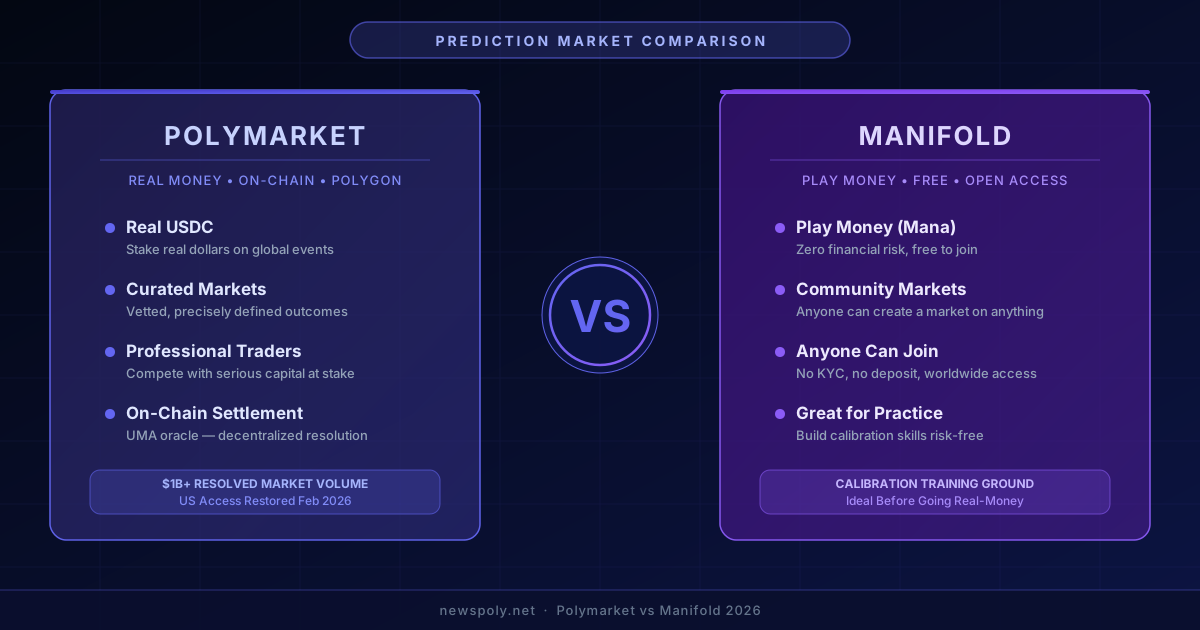
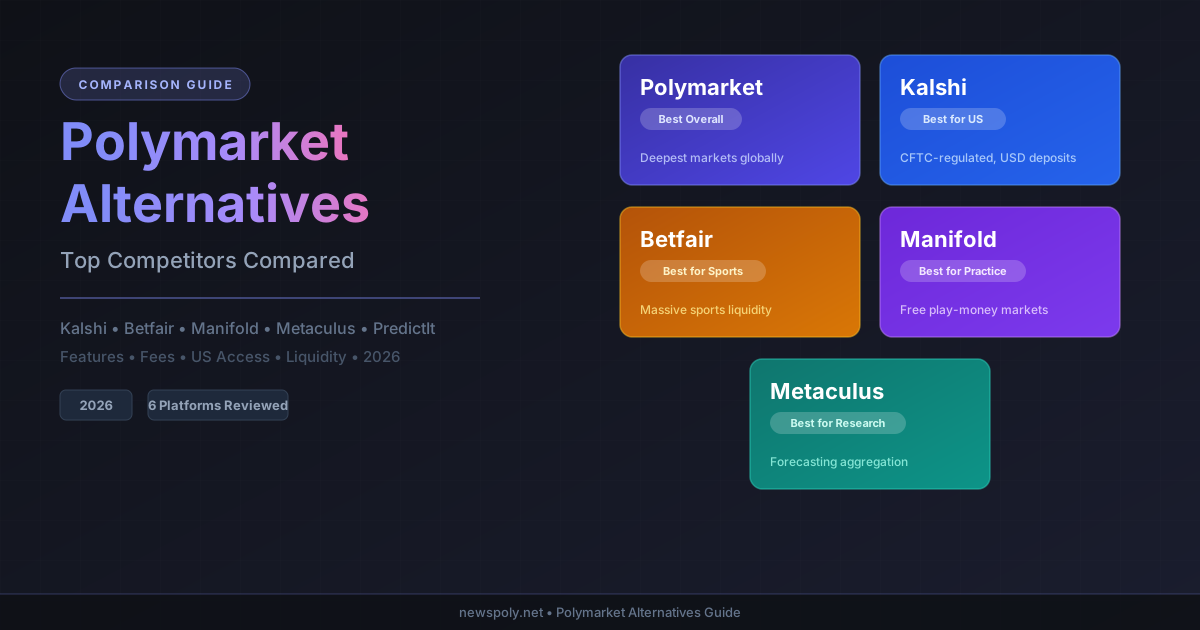
For US residents who want a legal alternative right now, Kalshi is also worth considering. We compare them directly in our Polymarket vs Kalshi analysis. For a broader view of alternatives, see Polymarket vs Manifold.
Political Market Quality
Both platforms cover US political markets, but the quality of those markets — measured by liquidity, spread tightness, and forecast accuracy — is not comparable.
Polymarket’s political markets are cited by mainstream media outlets, political analysts, and academic researchers as among the most accurate real-time probability estimates available anywhere. The 2024 US election markets on Polymarket attracted extraordinary global attention and proved more accurate than most polling aggregators — and the platform continues to expand political coverage in 2026, as covered in our guide to Polymarket 2026 election markets. PredictIt’s political markets are noisier, partly because the $850 cap prevents serious arbitrageurs from correcting mispricings efficiently.
If your goal is to use prediction markets as a forecasting tool rather than just a betting venue, Polymarket’s political probabilities are more reliable inputs.
Which Platform Is Right for You?
Choose PredictIt if:
- You are a US resident and Polymarket US access is still restricted when you read this
- You want a simple, familiar dollar-denominated interface with no crypto setup
- You trade recreationally with small stakes and US political markets are your only interest
- You are comfortable with the 10% profit fee and 5% withdrawal fee eating into returns
Choose Polymarket if:
- You are outside the US, or US access has been restored when you read this
- You want the lowest possible fees — no profit fees, no withdrawal fees
- You want to size positions beyond $850 based on your actual conviction
- You want access to crypto, sports, economics, and global event markets beyond US politics
- You want to leverage copy trading tools that require deep, liquid markets to function
Why Serious Traders Prefer Polymarket’s Depth
The pattern among sophisticated prediction market participants is clear: they gravitate to Polymarket. The reasons converge on a few core factors — depth, cost, and scale.
Deep liquidity means tighter spreads, which means more of your edge translates into actual profit rather than being captured by market friction. No position cap means you can size positions proportional to your confidence. Low fees mean you keep significantly more of your gross returns. And the breadth of markets means you can construct a diversified portfolio rather than concentrating in a single asset class.
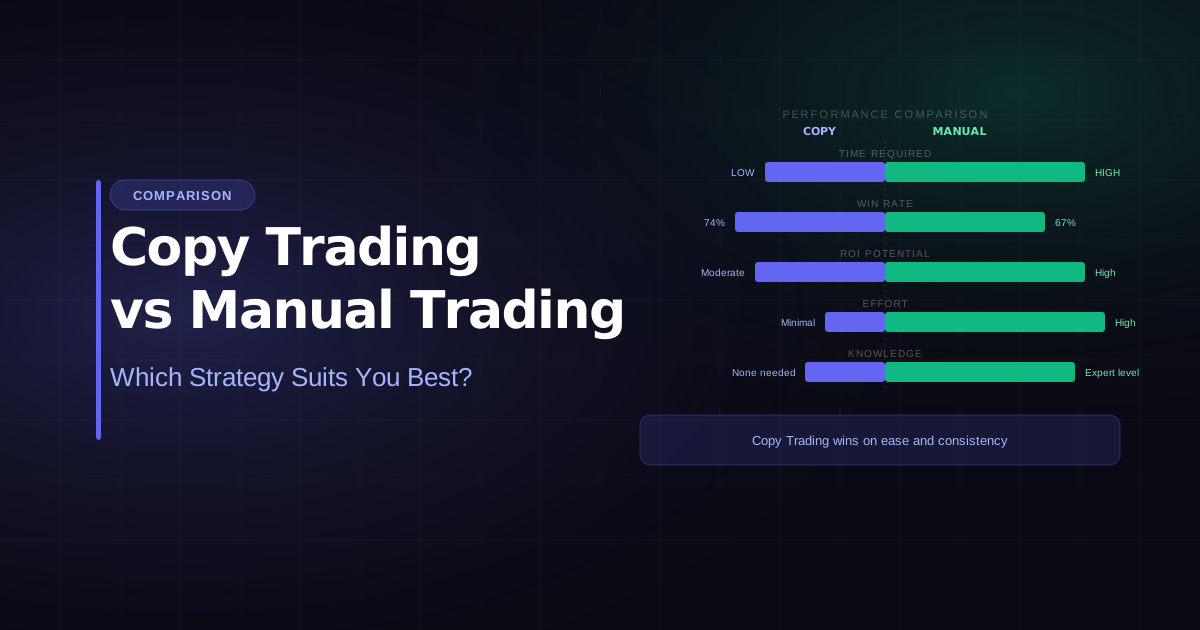
Copy trading — systematically following Polymarket’s best performers — is only possible because of this depth. PredictIt’s thin, capped markets make meaningful copy trading impossible. On Polymarket, tools like PolyCopyTrade can identify traders with genuine edge and replicate their positions at scale. For a detailed breakdown of how this compares to doing your own research, see our Polymarket copy trading vs manual trading comparison.
PredictIt served an important historical role in legitimizing real-money political prediction markets in the US. But for traders who are serious about returns, it is constrained by its own regulatory structure in ways that Polymarket is not. As the US regulatory environment continues to evolve, the case for PredictIt as a preferred platform weakens further.