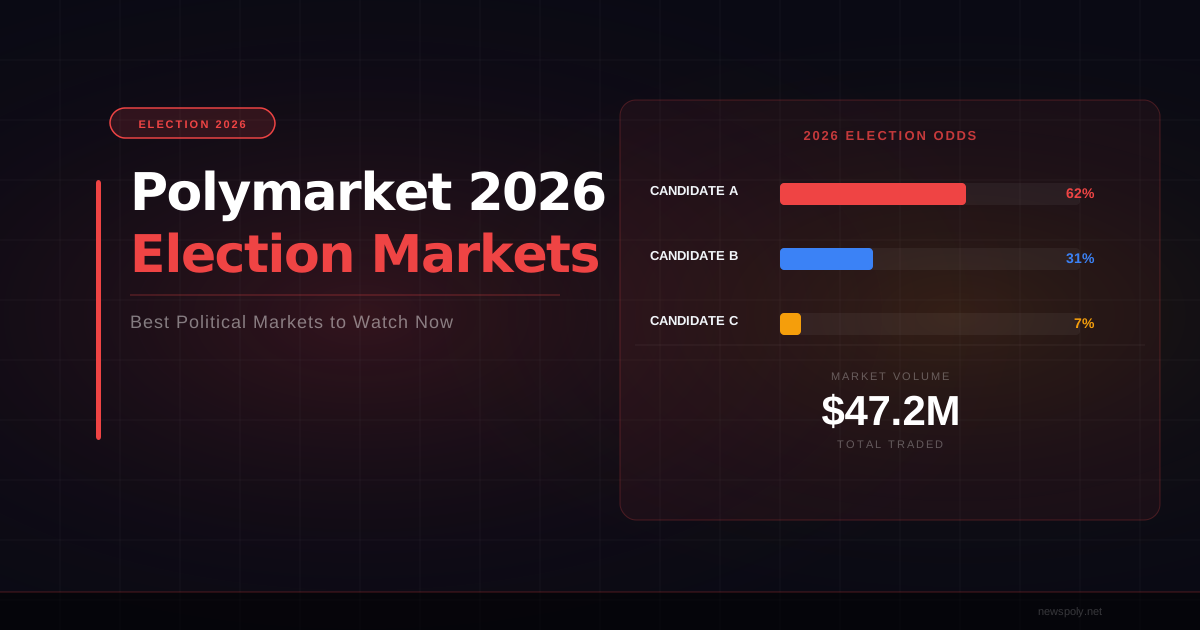
With November 2026 eight months away, Polymarket’s 2026 midterm election markets are already generating serious volume — and serious mispricing. Senate control, competitive House seats, and contested Governor races are all live right now, priced by a market that systematically over-reacts to early polling, fundraising headlines, and pundit narratives. For traders who understand how to read political probabilities, March 2026 is one of the most attractive entry windows of the entire election cycle.
This guide covers every major category of 2026 election market on Polymarket, how to interpret current pricing, where the clearest edges exist right now, and how to structure your trades across the months leading to election day. If you’re new to political markets on Polymarket, our Polymarket politics markets guide covers the fundamentals before you dive into specific races.
2026 US Midterm Elections Overview on Polymarket
The 2026 midterms are shaping up to be one of the most heavily traded electoral cycles in Polymarket’s history. All 435 House seats are up, 34 Senate seats are contested, and 36 Governor races are on the ballot. Polymarket has already opened markets on chamber control (Senate majority, House majority), individual competitive Senate races, a selection of Governor contests, and a growing number of House district markets in the most watched swing seats.
As of March 2026, the headline market — “Which party controls the Senate after November 2026?” — is trading in a tight band, reflecting genuine structural uncertainty. Historical patterns favor the party out of power in midterms, but the specific Senate map, presidential approval ratings, and economic conditions all push this cycle toward genuine competitiveness. The House majority market tells a similar story: currently priced as a near-coin-flip, with liquidity building steadily as the election approaches.
This is exactly the market environment where disciplined, data-first traders generate outsized returns. Uncertainty creates mispricing; mispricing creates edge. The key is knowing which signals to weight and which to ignore — a skill we cover in depth in our Polymarket accuracy analysis.
Key Races to Watch: Senate, House, and Governor Markets
Not all 2026 election markets are created equal. The best trading opportunities are concentrated in races where genuine uncertainty meets high liquidity — a combination that maximises both your ability to enter meaningful positions and the probability that prices will be meaningfully mispriced.
Senate Races
The 2026 Senate map is unusually competitive. Several states with seats up for election are genuine toss-ups given current polling, including key contests across the Mountain West, the South, and the Midwest. Senate control markets attract the most liquidity and the most sophisticated traders, which means mispricing tends to be smaller but still present — particularly in the months following major news events when retail traders over-react to narrative shifts.
The most actionable Senate markets right now are individual contested seats rather than the aggregate “party control” market. Individual race markets are less liquid than the chamber-control market, which means mispricing is larger and more persistent. A well-researched position in an individual Senate race can generate significantly better expected value than the headline market.
House Races
Polymarket’s House majority market is its most liquid political market for the 2026 cycle. Individual district-level markets are more niche, but several competitive swing-district markets are already live. These are especially interesting for traders who have genuine regional knowledge — local economic conditions, candidate recruitment quality, and district-level polling that national aggregators don’t weight correctly.
Governor Races
Governor markets are systematically under-traded relative to their informational value. Several 2026 Governor contests — particularly in large swing states — are live on Polymarket with thin liquidity and wide bid-ask spreads. This combination means entry prices are often meaningfully wrong, and patient traders using news-driven entry timing can pick up significant edge relative to the true underlying probability.
Key 2026 Polymarket Election Markets: Current Pricing Snapshot
The table below summarises the major 2026 election markets on Polymarket as of late March 2026, along with indicative current pricing and a qualitative edge assessment. Prices move daily — use this as a framework for your own research rather than a live quote sheet.
| Market | Yes Price | Liquidity | Edge Notes |
|---|---|---|---|
| Democrats win Senate majority | ~47¢ | ★★★★★ | Tight band; watch August polling for entry signals |
| Republicans win House majority | ~54¢ | ★★★★★ | Historical midterm pattern; incumbent party disadvantage priced |
| Key swing Senate seat — Mountain West | ~52¢ | ★★★ | Thin liquidity; structural models suggest 56–58% true prob |
| Key swing Senate seat — Midwest | ~44¢ | ★★★ | Incumbency advantage underpriced in early cycle markets |
| Large swing state Governor race | ~61¢ | ★★ | Thin; wide spreads; best entry on news dips |
| Competitive House district — Southwest | ~49¢ | ★★ | Genuine 50/50; watch candidate filing deadlines |
How to Read Political Market Prices
A price of 54¢ on “Republicans win House majority” means the market implies a 54% probability of that outcome. But interpreting that price correctly requires understanding several structural factors that cause political markets to persistently misprice probability at specific points in the election cycle.
The most important principle: early-cycle market prices (6–12 months before election day) systematically under-incorporate structural base rates and over-weight recent polling noise. A candidate who leads by 3 points in March polls does not have a meaningfully higher probability of winning in November than one trailing by 1 point — but Polymarket prices will typically reflect those early numbers as if they are highly predictive. The cognitive biases baked into collective market pricing are well-documented and consistently exploitable.
The second key principle: prices in thinly-traded individual race markets reflect the beliefs of a small number of traders, not a deep, efficient market. When a Governor race market has $50,000 in liquidity versus $5 million in the Senate control market, the individual race price is far more likely to be significantly wrong — and far more likely to correct sharply when new information arrives.
Historical Accuracy of Polymarket in Elections
Polymarket’s track record in electoral markets is strong relative to polling-only models but meaningfully imperfect — and understanding the pattern of errors is more valuable than the headline accuracy number. Our deep-dive analysis of Polymarket’s accuracy covers this in detail, but the key findings for election traders are:
- Aggregate chamber control markets: Accurate within 5–8 percentage points in the final 30 days; less reliable 6+ months out
- Individual race markets: Higher variance; specific races show 10–15 percentage-point errors that persist for weeks before correcting
- Over-reaction to debate moments: Consistent pattern of 5–10 point price swings on debates that revert within 72 hours
- Incumbency under-pricing: Early cycle markets consistently under-price incumbency advantage, particularly in Governor races
- Economic fundamentals lag: Macro economic conditions are incorporated slowly — prices frequently lag 2–3 weeks behind major economic data releases
Each of these patterns is a repeatable, systematic edge. The traders who generate consistent returns in election markets are not simply “good at politics” — they are good at exploiting the specific, predictable ways that political market prices are wrong.
Trading Strategies for 2026 Election Markets
The full toolkit for political market trading is covered in our top Polymarket trading strategies guide. For the 2026 cycle specifically, three approaches are particularly well-suited to current market conditions.
1. Structural Base Rate Trading
Historical midterm patterns are a genuine, underweighted signal in March 2026 prices. The party holding the White House loses House seats in midterms at a high historical rate. Where current market prices don’t fully reflect this base rate — either because recent polling is temporarily favorable to the incumbent party or because a specific strong candidate has distorted pricing — structural base rate trades have positive expected value. The key is separating genuine structural signals from narrative noise.
2. Thin Market Mispricing
Individual Senate and Governor race markets are thinly traded right now. A significant polling update, a major candidate announcement, or a fundraising disclosure will move these markets sharply. Being positioned before these information events — at prices that reflect the pre-event structural probability — is the classic early-cycle election market strategy. This requires patience and a willingness to hold positions through the interim noise, but the expected value of well-researched entry positions in thin markets is consistently strong.
3. News-Event Fade Trades
The single most repeatable short-term strategy in political markets is fading over-reactions to news events. Endorsements, fundraising numbers, early state polls, and pundit coverage all move Polymarket prices by more than their actual informational content justifies. Identifying these over-reactions and taking the opposing position — particularly in high-liquidity markets where the fade can be executed cleanly — is the strategy covered in detail in our Polymarket news trading guide.
Timing Entries and Exits Around Debates, Polls, and News Events
The election calendar between now and November 2026 provides multiple structured entry and exit windows. Understanding which events are likely to move markets — and by how much — is the foundation of election market timing strategy.
Key Calendar Events to Watch
- Primary season (May–August 2026): Candidate fields consolidate; markets for individual races become more liquid as nominees are confirmed. Thin-market positions taken now can be exited profitably as liquidity builds post-primary.
- Major polling releases (monthly): National and state-level polls move prices. The correct response to a single outlier poll is almost never to follow the price movement — it’s to fade it, unless the poll confirms a broader trend visible in aggregators.
- Senate and Governor debates (September–October 2026): Historically produce the largest short-term mispricing in political markets. Post-debate price movements of 5–10 points are common; these moves typically revert 60–80% within 72 hours as the market integrates the information more accurately.
- Economic data releases (monthly): CPI, unemployment, and GDP prints all move political markets more slowly than they should. There is typically a 1–2 week lag between a major economic data release and its full incorporation into election market prices — a persistent and exploitable inefficiency.
- October surprise window (October 2026): The highest-volatility period of the cycle. Positions should be sized conservatively entering October; the expected value of holding large positions through the final 30 days depends heavily on your confidence in your probability estimates relative to current market pricing.
Managing Political Market Risk
Political markets carry specific risk characteristics that differ from crypto, macro, or sports markets on Polymarket. The most important risk management principles for the 2026 cycle are covered in our Polymarket risk management guide, but the election-specific points are worth emphasising.
Correlation risk: Senate control, House control, and individual race markets are highly correlated — a national political shock that moves one will move all of them in the same direction simultaneously. Do not treat positions in multiple election markets as independent bets. Size your total election market exposure as a single correlated risk unit, not as a portfolio of uncorrelated positions.
Time decay and opportunity cost: Positions opened in March 2026 for a November 2026 resolution are capital committed for 8 months. The opportunity cost of that capital should factor into your position sizing. Generally, early-cycle election market positions should be smaller than your standard position size — the edge may be real, but it requires patient capital.
Liquidity risk in thin markets: Individual race markets can be difficult to exit quickly if a major news event moves prices against you. Always check the order book depth before entering a thin market position, and size accordingly. Using limit orders rather than market orders is essential in markets with wide bid-ask spreads.
Black swan event exposure: Candidate health events, unexpected withdrawals, and major exogenous shocks are low-probability but high-impact risks in any election market. Never size a single election market position large enough that a black swan event would meaningfully damage your overall bankroll.
Why Copy Trading Works Well for Political Markets
Political prediction markets are one of the categories where copy trading delivers the clearest, most consistent advantage over independent trading. The reasons are structural.
First, political market expertise is genuinely specialised. A former campaign staffer, political scientist, or policy analyst has real informational edges in specific races — edges that a generalist trader simply cannot replicate without investing disproportionate time in research. Copy trading allows you to access that expertise without having it yourself.
Second, political markets are emotionally demanding. Following 34 Senate races, parsing polling data, resisting the pull of political priors, and maintaining disciplined position sizing through months of noise is genuinely difficult for most traders. Automation removes the emotional component entirely — positions are copied mechanically, based on verified trader performance, not on how you feel about a particular candidate or narrative.
Third, the best political market traders on Polymarket have verifiable, on-chain track records specifically in election markets. You can see exactly which races they traded, at what prices, and what their returns were. This transparency is unique to blockchain-based prediction markets and makes trader selection far more rigorous than in any traditional financial context. If you want to identify and monitor top election market wallets directly, our Polymarket whale tracking guide covers how to find and follow high-performing wallets on-chain. For a full breakdown of how copy trading works mechanically, see our Polymarket copy trading guide.
Frequently Asked Questions
Are 2026 midterm election markets available on Polymarket right now?
Yes. As of March 2026, Polymarket has live markets for Senate control, House control, and a growing number of individual Senate, Governor, and House district races. Liquidity is building steadily as the November 2026 election approaches — entering positions now, before the high-liquidity sprint of the final 60 days, typically means better entry prices and less competition from sophisticated traders.
How accurate are Polymarket’s political market prices in the early cycle?
More accurate than individual polls, less accurate than polling aggregators combined with structural models. Early-cycle prices (6–8 months out) show larger errors than final-30-day prices, particularly in individual race markets with thin liquidity. The persistent pattern of incumbency under-pricing and news-event over-reaction creates specific, repeatable edges for disciplined traders.
What’s the best strategy for trading 2026 election markets in March 2026?
For most traders, the highest-expected-value approach right now is a combination of structural base rate positions in thin individual race markets (where incumbency and historical patterns are underpriced) and copy trading via a platform like PolyCopyTrade to access specialist political market expertise without the research burden. News-event fade trades in high-liquidity chamber control markets are the best short-term tactical play as the cycle progresses.
How do I manage the correlation risk between multiple 2026 election market positions?
Treat your total election market book as a single correlated exposure unit. A national political shock — a major economic event, a significant news story — will move Senate control, House control, and individual race markets simultaneously. The sum of your election market positions should represent a level of exposure you’re comfortable with in a scenario where all positions move against you at once. Our risk management guide covers portfolio-level position sizing in detail.