I spent a decade as a professional sports bettor before Polymarket existed. The shift to prediction markets changed my edge calculation completely. Traditional sportsbooks are designed to limit winners and extract value from the market through the vig. Polymarket is a neutral exchange — it takes nothing from the outcome. That single structural difference changes everything about how sustainable edge is built and maintained.
This guide covers sports prediction markets on Polymarket from first principles: the structural advantages, how to identify genuine value, sport-specific considerations, and the specific mistakes that erode edge for traders coming from a traditional sports betting background. For a deeper look at the structural comparison, our Polymarket vs sports betting guide provides the full analysis.
What Sports Markets Are Available on Polymarket?
Polymarket's sports market coverage varies by season and demand. The consistently available categories include:
- NFL — Super Bowl winner, conference champions, season win totals, playoff bracket outcomes
- Soccer/Football — Champions League, World Cup, Premier League, and major tournament outcomes
- Tennis — Grand Slam winners, tournament outright markets
- NBA — Championship, conference finals, MVP markets
- Golf — Major championship outright winner markets
- Boxing and MMA — Individual fight outcome markets for major events
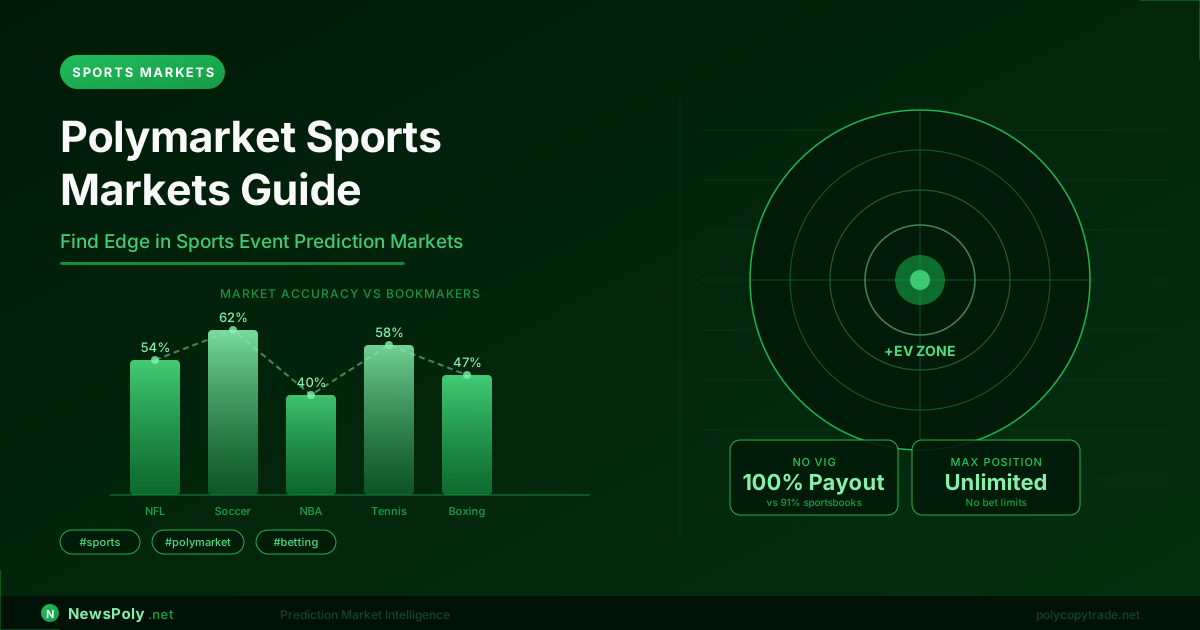
Market availability for less mainstream sports varies. The highest-quality markets — in terms of liquidity and efficient pricing — are typically the NFL, Champions League, and Grand Slam tennis markets, which attract the most sophisticated sports traders.
The Three Structural Advantages Over Sportsbooks
1. Zero Vig on Resolution
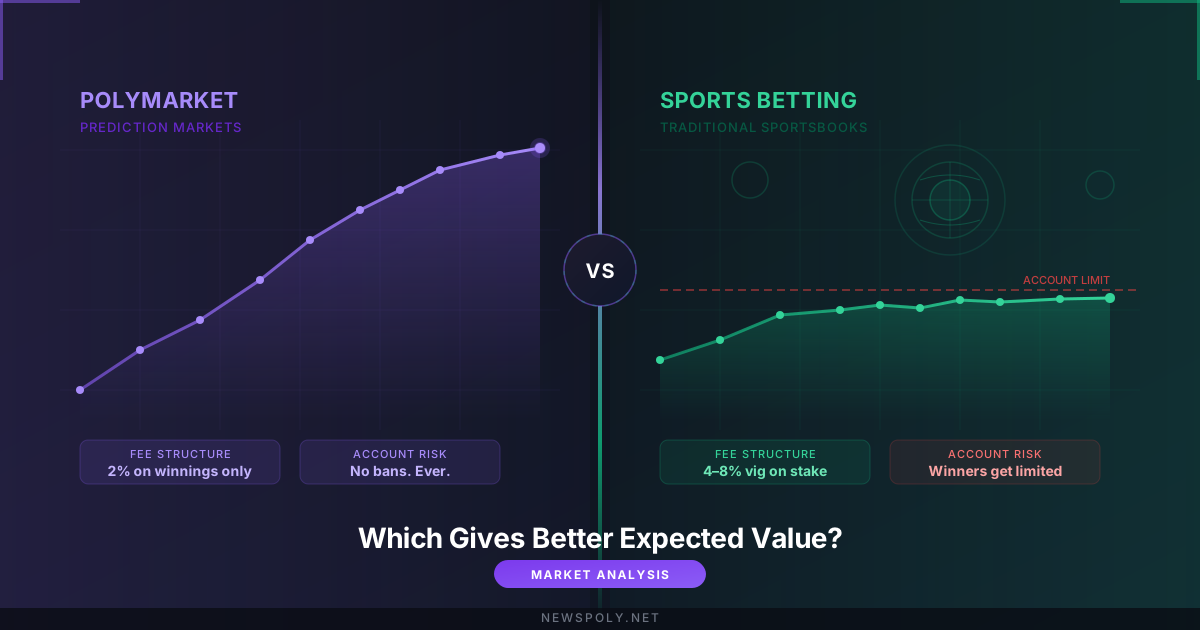
Traditional sportsbooks build a margin (the vig or juice) into every market. On a standard spread market, you're paying -110 on both sides — meaning you must win 52.4% of your bets just to break even. Polymarket charges no vig. A YES token that resolves correctly pays out $1.00, regardless of what you paid for it. Your edge is entirely determined by your probability assessment accuracy, not by fighting a structural tax on every trade.
The compounding effect of this over hundreds of trades is enormous. A sports bettor who correctly prices outcomes at 55% winning 55% of the time at a sportsbook might net 2–3% ROI. The same ability deployed on Polymarket produces approximately 5–6% ROI, because the vig isn't eating your edge.
2. No Bet Limits or Account Bans
Every professional sports bettor has experienced being limited or banned by a sportsbook after winning consistently. Bookmakers actively profile and restrict winning customers — it's their standard business model response to sharp action. Polymarket cannot ban a wallet or limit a position. The only limit is available liquidity in the market, and major markets have millions in depth.
3. Pre-Event Market Duration
A traditional sportsbook opens lines 5–7 days before an event. Polymarket sports markets can open months in advance for tournament outrights and season-level predictions. This creates opportunities for long-term value plays — correctly pricing a team or athlete at the start of a season before the broader market has fully processed the relevant information.
How to Find Value in Polymarket Sports Markets
The Base Rate Framework
Every sports market on Polymarket has an implied probability at current price. The fundamental question is whether that probability is accurate. The most reliable value-finding method in sports prediction markets is the same as in other market categories — systematic base-rate analysis — as covered in our guide to finding mispriced markets.
For sports markets specifically, useful base rates include:
- Historical win rates by seed/ranking — For tennis Grand Slams, 1st seeds win roughly 25% of the time across all four majors. If a top seed is priced at 40% to win a major, that's a significant deviation from the base rate that requires justification
- Home/away performance splits — In soccer, home advantage is consistently underpriced in early tournament bracket markets
- Rest and schedule factors — Teams on short rest or through-the-week fixture congestion have measurable performance declines that aren't always reflected in market prices
- Historical market accuracy — For well-studied sports (NFL, EPL), Betfair closing prices are highly efficient. For less liquid sports, there's more room for systematic edge
Cross-Market Arbitrage and Line Shopping
Comparing Polymarket prices to Betfair, Pinnacle, and other liquid exchanges surfaces genuine mispricing opportunities. When Polymarket has a team at 65% and Betfair — which has substantially higher liquidity and more professional traders — has them at 72%, the 7-point gap warrants serious investigation. One of the two markets is wrong, and the arbitrage opportunity (or the directional bet toward convergence) is actionable.
This cross-platform comparison is one of the most reliable edges for traders with access to multiple markets and the analytical framework to evaluate which pricing is more accurate. See how this applies in the broader Polymarket trading strategies guide.
Injury and News Timing
Sports markets are uniquely sensitive to real-time information about player availability and fitness. A key injury announcement can move a market 15–20 percentage points in minutes. Traders who have access to injury information — from official team reports, reliable beat journalists, or social monitoring of athlete and club communications — before it is reflected in market prices have a genuine, legally-unambiguous informational edge.
Important: on Polymarket, there is no prohibition on trading on publicly available information before it's priced in. If you see a credible injury report before the market has adjusted, acting on it is simply fast information processing, not inside trading. Using limit orders when entering on injury news avoids the slippage cost of hitting the market at a rapidly moving price.
Sport-Specific Strategy Notes
Tennis: Individual Match and Tournament Outrights
Tennis markets are among the most mispriced on Polymarket for a specific reason: the sport has high variance for shorter events (best-of-3 matches) but highly predictable long-run outcomes for tournament outrights. Markets consistently over-price the variance at the individual match level and under-price the dominance of top players in outright markets. The best tennis edges are in outright tournament markets, not individual match bets. Reading the probability chart for a player's outright market over the weeks leading into a tournament often reveals pricing drift that opens entry opportunities well before the event starts.
NFL: Season-Level vs. Game-Level Markets
Super Bowl and conference champion markets open very early and tend to over-price popular teams (Cowboys, Patriots historically) and under-price consistent but less "media-attractive" teams. The public bet-weighted pricing that drives these early-season markets is less sophisticated than what drives game-level markets closer to kickoff. Contrarian positions against public darlings in pre-season markets have historically performed well.
Soccer: Tournament Bracket Dynamics
In knockout tournament markets, markets often fail to properly account for draw probabilities and penalty shootout base rates. Teams that are strong in normal time but weaker in extra time and penalties are systematically over-priced in late-tournament markets. Tracking historical penalty shootout performance by team and key players is a niche edge that few Polymarket sports traders exploit.
Position Sizing and Risk Management for Sports Markets
Sports markets present specific risk management challenges compared to other Polymarket categories. Before entering a sports market, always calculate your expected value explicitly — the absence of vig means even a 52% win rate at fair odds generates positive EV, which is a lower bar than most traders from a sportsbook background expect. Key principles:
- High variance, binary resolution — Unlike political or macro markets that can drift over months, sports markets resolve sharply on a specific date. Position sizing must account for the higher per-event variance
- Correlation risk in tournament markets — If you hold positions on multiple teams in the same tournament, those positions are correlated; apply the cluster-exposure rules from our risk management guide
- Pre-event vs. in-play dynamics — Polymarket does not currently offer in-play markets for most sports; all positions must be established before the event starts, which limits certain hedging strategies
The same 1–5% bankroll per position rule applies to sports markets, with sports-specific adjustment: given the binary, high-variance nature of individual event outcomes, the lower end of the range (1–2%) is generally more appropriate than the higher end, unless your edge on a specific market is very well-documented and large. For traders who want a mathematical framework for sizing based on their exact edge estimate, the Kelly Criterion guide shows how to calculate the optimal fraction for any market and why half-Kelly is nearly always the right choice in practice.
Traders who want exposure to sports prediction market returns without handling individual market selection and sizing can use PolyCopyTrade to automatically copy positions from traders with verified track records in sports markets — implementing the position sizing discipline above at the system level, without manual execution on each event.
Frequently Asked Questions
Are there live in-play sports markets on Polymarket?
Polymarket primarily offers pre-event markets, not live in-play betting. Some markets may remain open during events if resolution timing allows, but the platform is not structured as a live betting exchange in the way that Betfair or traditional sportsbooks are. This is a meaningful limitation for traders whose edge depends on in-play information — pre-event value identification is the primary sports market strategy on Polymarket.
How liquid are sports markets on Polymarket compared to political markets?
Major political markets — US presidential elections, UK general elections — typically have deeper liquidity than sports markets. Top-tier sports markets (Super Bowl, Champions League) can have hundreds of thousands to low millions in liquidity, which is sufficient for most traders. Lower-profile sports markets may have limited depth, which creates both opportunity (mispricing is more common) and risk (execution cost is higher). Always check available liquidity before sizing a position.
Can I hedge a Polymarket sports position if the event goes against me?
Yes, by taking the opposite position in the same market. If you hold YES tokens at 40 cents and the price moves to 30 cents after an adverse development (e.g., key player injury), you can buy NO tokens to reduce your net exposure. The mechanics of hedging on Polymarket are covered in our guide to reading Polymarket odds, including how to calculate the net position and residual exposure after a hedge.