Polymarket's payout mechanics are elegantly simple on the surface—winning shares pay $1, losing shares pay $0—but the details underneath matter a great deal. Understanding resolution timing, the 2% fee structure, who actually decides outcomes, and what happens when a result is disputed will make you a more confident trader. This guide covers everything from the moment you place a position to the moment USDC lands in your wallet.
How Binary Market Resolution Works
Every binary market on Polymarket has two possible outcomes: YES and NO. Each share is always worth either $1.00 or $0.00 at resolution—nothing in between.
- YES shares pay out $1.00 each if the event occurs.
- NO shares pay out $1.00 each if the event does not occur.
- The opposing side receives $0.00 and those shares simply expire worthless.
Because a YES share and a NO share together always sum to $1.00, the market is always in balance. That is the core mechanic behind how Polymarket works as a prediction market.
Let winnings accumulate automatically. PolyCopyTrade enters and exits Polymarket positions on your behalf — payouts go straight to your wallet, fully automated.
How Much Do You Actually Earn?
Your profit depends on two variables: how many shares you hold and what price you paid for them. Here is a worked example.
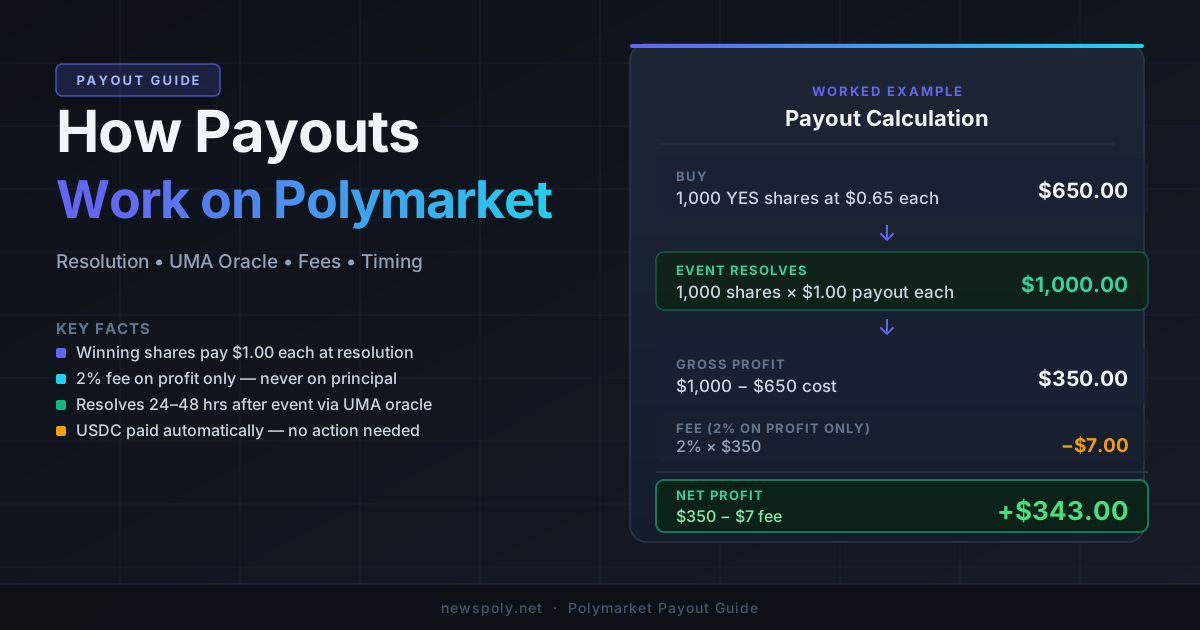
Suppose a market is trading at $0.65 on YES—meaning the crowd thinks there is a 65% chance of the event happening. You buy 1,000 YES shares at that price:
- Total cost: 1,000 × $0.65 = $650
- If YES resolves: 1,000 × $1.00 = $1,000 payout
- Gross profit: $1,000 − $650 = $350
That $350 represents a 53.8% return on your $650 stake—in a single market. Understanding reading odds correctly is what separates positions with genuine edge from ones that only look attractive.
The 2% Fee on Winnings
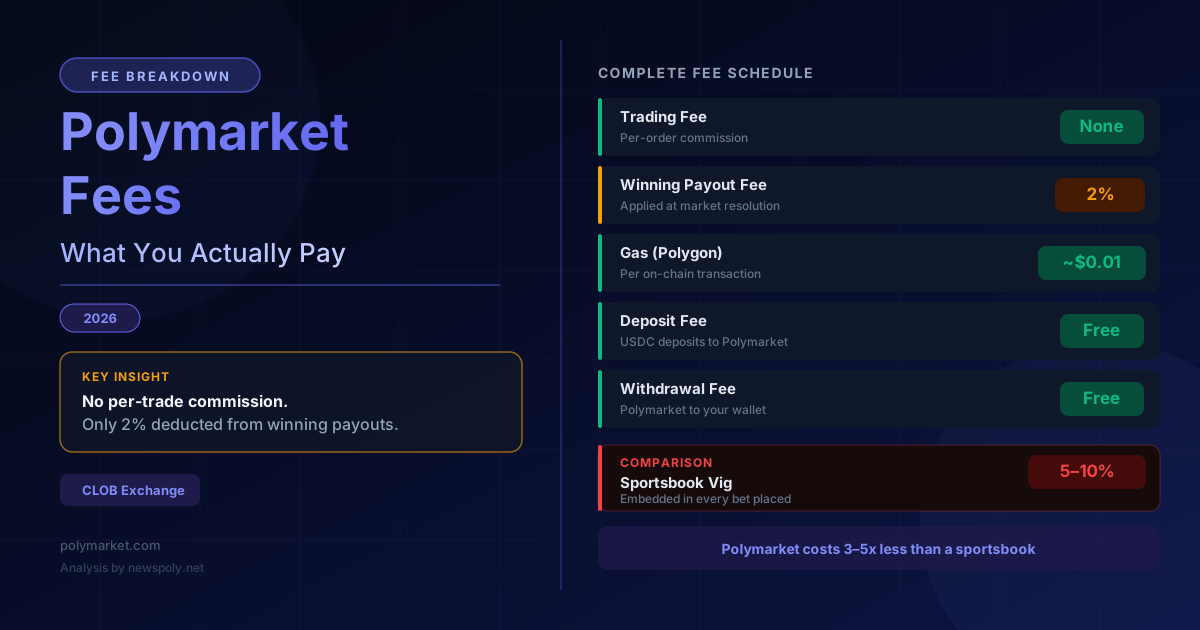
Polymarket charges a the 2% fee only when you win. Crucially, the fee is applied to your profit, not your principal. Using the example above:
- Gross profit: $350
- Fee: 2% × $350 = $7.00
- Net profit: $343.00
- Total received in wallet: $650 (principal) + $343 (net profit) = $993.00
There is no fee charged on losing positions—you simply lose the amount you invested. There are also no deposit fees, no withdrawal fees, and no maker/taker spread on the fee side (though the order book spread itself is a cost to be aware of).
Who Resolves Markets? The UMA Oracle
Polymarket uses the UMA (Universal Market Access) protocol as its resolution oracle. UMA is a decentralized, optimistic oracle that works as follows:
- Assertion: After an event concludes, a proposer submits the outcome (YES or NO) to the UMA smart contract along with a bond.
- Challenge window: The assertion sits in a 24-hour dispute window. If no one challenges it, the outcome is accepted automatically and resolution proceeds.
- Off-chain data: Proposers reference publicly verifiable sources—official results, reputable news outlets, government data—to support their assertion.
- Community verification: Token holders can review the assertion and raise a dispute if they believe it is incorrect.
This optimistic approach means resolution is fast in the vast majority of cases, with disputes handled only when genuinely needed.
How Long Does Resolution Take?
Most markets resolve within 24–48 hours of the underlying event completing. The timeline typically looks like this:
- Hour 0: Event concludes (election called, game ends, announcement made).
- Hours 1–6: A proposer submits the outcome to UMA.
- Hours 6–30: The 24-hour dispute window runs.
- Hour 30+: If undisputed, the contract finalizes and payouts are distributed automatically to wallets.
High-profile markets—elections, major sporting events—can sometimes take slightly longer if the real-world result itself is slow to confirm. Markets will not resolve until the outcome is unambiguous.
What If Resolution Is Disputed?
When a proposer submits an outcome that another party believes is incorrect, the UMA dispute mechanism is triggered:
- Dispute raised: A disputer posts a bond and flags the assertion as incorrect.
- Escalation to DVM: The dispute escalates to UMA's Data Verification Mechanism (DVM), where UMA token holders vote on the correct outcome.
- Voter resolution: Token holders are economically incentivized to vote with the majority (and therefore with the truth). The vote concludes over a 48-hour period.
- Settlement: The winning side—proposer or disputer—receives the other's bond. The market then resolves according to the voted outcome.
Disputes are rare but the mechanism exists precisely to prevent any single party from manipulating resolution. Polymarket itself cannot override an UMA settlement. For a deeper look at whether the platform is trustworthy overall, the guide to Polymarket's legitimacy covers its regulatory status, the UMA oracle, and the CFTC enforcement history.
Let winnings accumulate automatically. PolyCopyTrade enters and exits Polymarket positions on your behalf — payouts go straight to your wallet, fully automated.
How to Claim Your USDC After Resolution
Here is the good news: you do not need to do anything. Polymarket resolution is fully automatic. When a market settles, the smart contract calculates each wallet's winning share balance, deducts the 2% fee, and pushes the net USDC directly to your connected wallet.
There is no "claim" button to press, no withdrawal transaction to initiate from the market itself, and no deadline to collect. The funds appear in your Polymarket balance (which is your on-chain wallet balance) as soon as the contract executes—usually within minutes of resolution finalizing.
From there, if you want to move funds off-platform, see our full guide on withdrawing your USDC to an external wallet or exchange.
What Happens to Losing Shares?
Losing shares simply become worthless. No action is required on your part—they are not "returned," they do not need to be sold, and there is no burn transaction you need to trigger. The contract records them as having $0 value and your position closes automatically.
Your total loss is exactly the amount you paid for those shares and nothing more. Polymarket positions cannot go negative—unlike leveraged products, your downside is always capped at your initial stake.
What About Multi-Outcome (Categorical) Markets?
Not every Polymarket market is binary. Categorical markets offer multiple outcomes—for example: "Who wins the 2026 World Cup?" with dozens of country options. The resolution logic still follows the same principle:
- Only one outcome pays $1.00 per share—the one that actually occurs.
- All other outcomes resolve to $0.00.
- The 2% fee on profit still applies to the winning outcome.
In categorical markets, prices across all outcomes always sum to approximately $1.00 (accounting for the spread). If you hold a 10% probability outcome that wins, your return is substantial—but the vast majority of categorical positions will resolve worthless. Position sizing matters even more in these markets; the principles in the risk management guide apply directly to managing exposure across multiple categorical outcomes.
Selling Before Resolution—You Do Not Have to Wait
One of the most underused features of Polymarket is the ability to exit a position before the event resolves. You are never locked in.
If you bought YES at $0.65 and the price later rises to $0.88—perhaps because new information makes the outcome more likely—you can sell your shares at $0.88 and pocket the difference immediately. Using limit orders when you exit lets you set a precise target price rather than accepting whatever the market offers at the moment you click sell. You do not need to wait for the event to conclude or for UMA to settle the result.
Early exits are useful when:
- You want to lock in profit after a price move in your favor.
- You want to cut losses if the price moves against you.
- You need liquidity before resolution timing is clear.
- The resolution is expected to take longer than you want to wait.
When you sell before resolution, you pay no fee—the 2% fee only applies to positions held all the way to settlement.
Let winnings accumulate automatically. PolyCopyTrade enters and exits Polymarket positions on your behalf — payouts go straight to your wallet, fully automated.
Frequently Asked Questions
Does Polymarket pay out immediately after an event ends?
Not instantaneously, but usually within 24–48 hours. Resolution requires the UMA oracle to process the outcome through its dispute window. In practice, most major markets settle within a day of the real-world result becoming clear. You will see your USDC balance update automatically once the smart contract executes.
Is the 2% fee taken from my total payout or only my profit?
Only your profit. If you invested $650 and received a $1,000 payout, your profit is $350. The 2% fee is $7 (2% of $350), not $20 (2% of $1,000). Your principal is always returned in full on winning positions.
What happens if a market resolves incorrectly?
If UMA's oracle produces an incorrect result and it is not disputed within the 24-hour window, the incorrect resolution will stand—which is why the dispute mechanism exists. If you believe a resolution is wrong, you can raise a dispute yourself by posting a bond through UMA. Disputes that succeed result in the outcome being corrected before payouts finalize.
Can I have multiple open positions resolve at the same time?
Yes. Each market is an independent smart contract. If you hold positions across ten different markets that all resolve on the same day, each contract executes independently and all winning payouts are deposited to your wallet automatically. There is no queue or batching delay between markets.