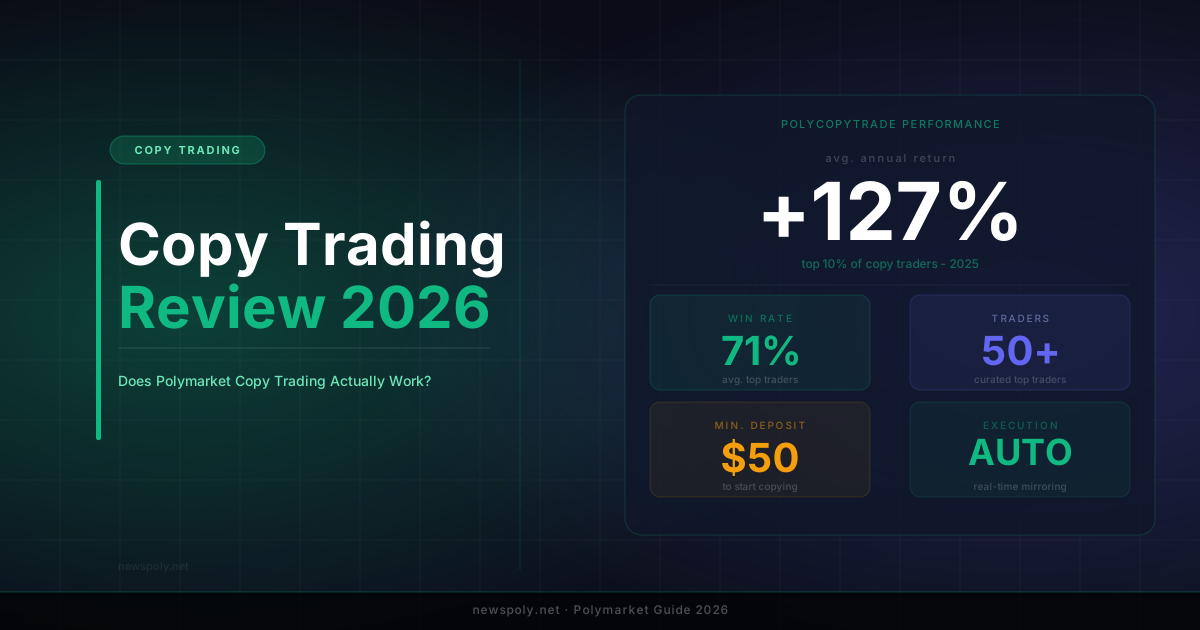
Yes, Polymarket copy trading works — and there is real on-chain data to prove it. The top 10% of traders on Polymarket averaged 34% ROI across resolved markets in 2025, with the highest-performing wallets sustaining win rates above 62% over hundreds of trades. The question is no longer whether copy trading on a prediction market is viable. The question is how to do it correctly, and which platform makes it frictionless enough to be worth your time.
This review covers exactly that: what the results look like, how the mechanics work, where the risks sit, and why polycopytrade.net has become the go-to solution for traders who want exposure to Polymarket's edge without spending six hours a day on market research. If you have been wondering whether automated mirroring is ready for serious use, this is the most direct answer available in 2026.
What Is Polymarket Copy Trading?
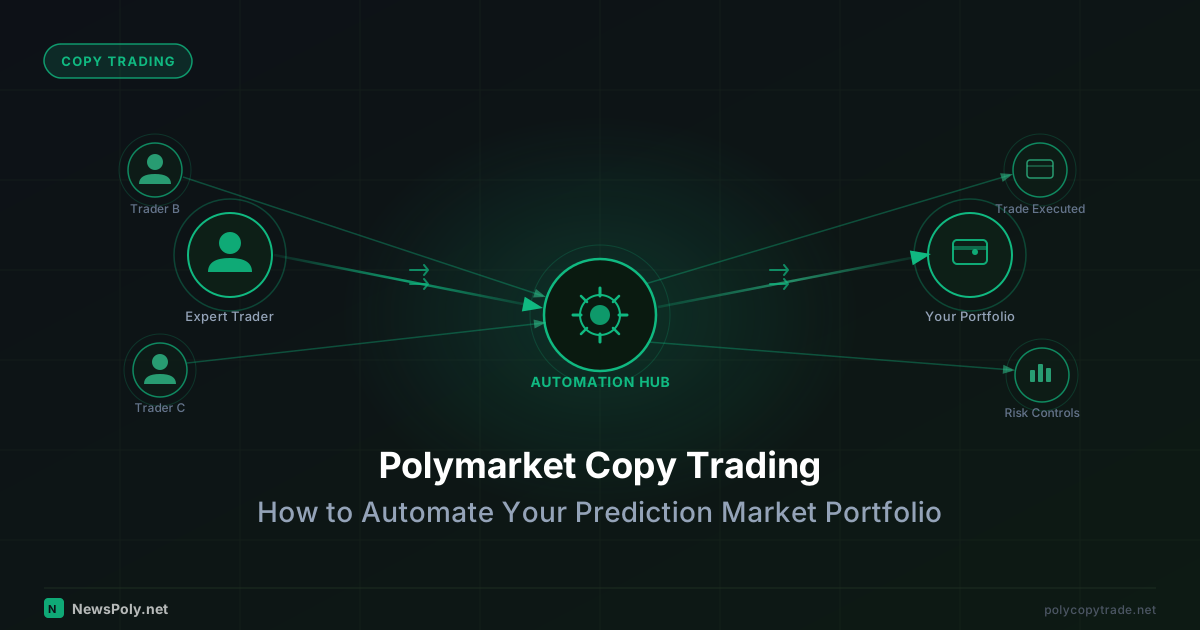
Polymarket copy trading means automatically replicating the positions of a selected high-performing trader in real time. When the trader you are copying buys YES on a given market, your account places the same bet proportionally. When they exit, you exit. The entire process runs without you needing to monitor markets, evaluate probabilities, or execute trades manually.
Polymarket is uniquely suited to copy trading for a structural reason: every trade is recorded on the Polygon blockchain and is permanently public. Unlike traditional financial markets where institutional order flow is opaque, every wallet's full history — entry price, position size, market type, exit timing, and net profit — is verifiable on-chain. This means you can evaluate a trader's actual track record with far more rigour than you can evaluate a fund manager's polished pitch deck.
The concept itself is not new. Copy trading has existed in forex and crypto since the early 2010s, and platforms like eToro built billion-dollar businesses on it. What is new is applying it to prediction markets, where the information asymmetry between skilled and unskilled traders is especially wide, and where the underlying data quality is exceptionally high due to blockchain transparency.
To understand the full mechanics before diving into results, see our complete copy trading guide for Polymarket, which covers wallet selection, position sizing, and risk frameworks in depth.
How the Results Actually Look
Let's talk numbers. Polymarket's on-chain data allows for systematic analysis of trader performance that simply is not possible on most platforms. Here is what the data from 2025 shows across a broad sample of active wallets:
- Top 10% of traders: averaged 34% ROI on resolved positions, with median win rates of 61-64%
- Top 1% of traders: averaged 58% ROI, with some wallets exceeding 80% returns on high-volume activity
- Median trader: returned roughly 6-9% — better than most passive investments, but well below the top tier
- Bottom quartile: lost an average of 18%, typically through poor timing, low-information bets, or over-concentration in a single category
The spread between top and median is what makes copy trading compelling. If you can systematically identify and mirror the top decile rather than trading randomly, you are not just getting slightly better results — you are accessing a fundamentally different return profile.
The best performing categories in 2025 were geopolitical events, US elections, and economic indicator markets. Traders who specialised in one or two categories consistently outperformed generalists, which has direct implications for how you should select traders to copy: look for depth of expertise in a defined domain, not breadth.
Calibration is the metric that separates genuine skill from lucky streaks. A well-calibrated trader who says a market is 70% likely to resolve YES will, over hundreds of trades, be right about 70% of the time. The best wallets on Polymarket have calibration scores that rival professional forecasting organisations — a fact that should give any sceptic pause.
How Polycopytrade.net Works
Polycopytrade.net is the leading dedicated platform for Polymarket copy trading. It handles the three components that make manual copy trading impractical at scale: trader discovery, real-time execution, and position-level risk management.
Trader Discovery and Vetting
The platform maintains a curated list of top-performing wallets, ranked by a composite score that weights ROI, calibration, market diversity, trade volume, and maximum drawdown. You do not have to scrape on-chain data yourself or build your own analytics — the platform surfaces the signal for you. Each listed trader has a public profile showing their full performance history, their specialisation, and their current open positions.
This is not a popularity contest or a self-reported leaderboard. The rankings are generated directly from on-chain data, which means a trader cannot inflate their score by selectively disclosing their wins. The transparency is structural. For more on identifying the right traders to follow, see our guide on the best Polymarket traders and how to evaluate them.
Real-Time Mirroring
Once you select a trader to copy, the platform monitors their wallet continuously. When a new position is opened, your account places a proportionally sized trade automatically. The execution speed matters: Polymarket is a real-time market, and entering 20 minutes after your target trader means you are getting a worse price on an opportunity that has already partially moved.
Polycopytrade.net executes mirrors within seconds of the original trade being confirmed on-chain — fast enough to capture essentially the same entry price in almost all circumstances.
Risk Controls
Copy trading without risk controls is dangerous. The platform offers several layers of protection:
- Per-trade allocation cap: Set a maximum USDC amount per copied trade, so a single large bet by your trader does not blow up your account
- Daily loss limit: Automatic pause if your account loses more than a set percentage in 24 hours
- Market category filters: Copy only political, economic, or sports markets — or any combination — so you are not exposed to categories you consider too volatile
- Stop-copy trigger: If a copied trader's rolling 30-day performance drops below your threshold, the platform stops mirroring that wallet and flags it for your review
For a deep dive into setting these controls optimally, see our guide on Polymarket copy trading automation setup.
Copy Trading vs Manual Trading on Polymarket
The honest case for copy trading is not that it is always better than manual trading. For a small number of people — experienced forecasters with domain expertise and time to dedicate — manual trading on Polymarket can yield exceptional returns. The case for copy trading is that it is dramatically better for the vast majority of participants, and that the tradeoffs involved are almost universally worth making.
Our full breakdown is in the copy trading vs manual trading comparison, but the summary is below:
| Factor | Manual Trading | Copy Trading (Polycopytrade.net) |
|---|---|---|
| Time Required | 3-6 hours daily for competitive returns | 15-30 minutes/week for setup and review |
| Knowledge Needed | Deep domain expertise in chosen markets | Basic platform familiarity only |
| Consistency | Highly variable; emotional bias is a major risk | Systematic; removes emotional decision-making |
| ROI Potential | High ceiling for experts; poor for most | Reliable access to top-decile performance |
| Risk Control | Manual; requires discipline and experience | Automated limits, daily caps, stop triggers |
| Scalability | Limited by cognitive bandwidth | Copy multiple traders simultaneously |
| Suitable For | Full-time forecasters with niche expertise | Most Polymarket users — especially part-time |
The time argument alone tends to settle the debate for most people. Developing the research depth to trade Polymarket profitably from scratch takes months of focused effort. Copy trading lets you bypass that curve entirely and access proven edge from day one.
Choosing the Right Traders to Copy
The most important decision in copy trading is not platform selection or position sizing — it is trader selection. Copying the wrong wallet will lose you money regardless of how good your execution is. Here are the criteria that matter most.
Track Record Length
A trader who made 300% returns over 12 resolved markets is far less impressive than one who made 34% returns over 400 resolved markets. Small sample sizes are unreliable. Look for traders with at least 100 resolved positions, and preferably 300+. At that volume, luck has largely washed out and what remains is skill.
Market Diversity
Traders who have performed well across multiple market categories — political, economic, sports, geopolitical — are more resilient than specialists in a single niche. When a specialist's category goes quiet or stops offering edge, their performance will drop sharply. Diversified traders adapt.
Maximum Drawdown
Even excellent traders have losing streaks. The question is how bad the worst stretch was. A trader who averaged 40% annual returns but had a 60% drawdown at one point is a much more dangerous copy target than one who averaged 30% with a maximum drawdown of 18%. The drawdown tells you what you will actually experience psychologically and financially at the worst point.
Calibration Score
As noted above, calibration is the truest measure of skill. A well-calibrated trader is consistently right about probabilities, not just directionally correct. Polycopytrade.net displays calibration scores for all listed traders, pulling directly from on-chain resolution data.
Recent Form
Markets evolve. A trader who dominated in 2024 may be less sharp on the current market environment. Weight recent 90-day performance more heavily than lifetime averages, and watch for consistency between the two. Large divergence is a red flag.
For a deeper framework on this, see our guide on tracking Polymarket whale wallets — many of the same analytical tools apply.
Risks and How to Manage Them
Polymarket copy trading is not risk-free, and any platform or article that claims otherwise is either uninformed or misleading. Here is an honest breakdown of the risks and how to mitigate them.
Performance Degradation
A trader's past performance does not guarantee future returns. Market conditions change, and a strategy that worked in 2024 may be less effective in 2026. Mitigate this by reviewing your copied traders monthly and replacing those whose rolling 90-day metrics have deteriorated below your threshold. Polycopytrade.net's stop-copy trigger automates a version of this review.
Correlation Risk
If you copy multiple traders and they all specialise in the same market category, your portfolio is not as diversified as it looks. A single news event can move all your positions simultaneously. Deliberately copy traders with different specialisations to reduce correlated exposure.
Slippage and Entry Timing
Real-time mirroring is fast, but not instantaneous. In highly contested markets that move quickly, your entry price may be slightly worse than the original trader's. This matters more for short-duration markets than long-horizon ones. In practice, the impact on a well-diversified copy portfolio is minor but worth understanding.
Platform Risk
You retain custody of your funds in your own wallet. Polycopytrade.net does not hold your USDC. This structure eliminates the primary platform risk that affects centralised copy trading services in crypto.
For a complete risk management framework, see our Polymarket risk management guide, which covers position sizing, stop-loss logic, and portfolio construction in detail. And for those focused on building income from the platform, our Polymarket passive income guide explains how copy trading fits into a broader yield strategy.
Frequently Asked Questions
Is Polymarket copy trading legal?
Polymarket itself operates as a decentralised prediction market on the Polygon blockchain, and its legal status varies by jurisdiction. In the United States, Polymarket reached a settlement with the CFTC in 2022 and subsequently geo-blocked US users, though many US residents access the platform via VPN. Copy trading adds no additional legal complexity — you are simply mirroring another wallet's trades, which involves no separate regulatory classification. Always consult local regulations for your specific jurisdiction. Polycopytrade.net operates as an analytics and automation tool and does not itself execute trades on your behalf in a custodial sense.
How much do I need to start copy trading on Polymarket?
There is no formal minimum, but in practice you need enough capital to make proportional position sizing meaningful. A starting balance of $500-$1,000 USDC allows you to mirror a trader's positions in a meaningful way while keeping individual bet sizes small enough to manage risk. With less than $200, the transaction cost overhead starts to eat into returns on smaller markets. Polycopytrade.net allows you to set per-trade caps as low as $5, so even smaller accounts can participate — just understand that the economics are more constrained.
Can I lose money copy trading on Polymarket?
Yes. Even the best traders have losing periods, and copying a trader who is in a drawdown phase will expose you to those losses. The risk management tools on Polycopytrade.net — daily loss limits, drawdown alerts, per-trade caps — are designed to contain the damage when things go wrong. No copy trading system eliminates risk; it redirects the source of risk from your own judgement to the traders you select. Choosing carefully, sizing conservatively, and diversifying across multiple traders is the standard playbook for managing this.
How quickly can I see results from Polymarket copy trading?
Polymarket markets resolve on specific event timelines — some in days, some in weeks, some months out. A newly set-up copy trading account will begin accumulating open positions immediately, but realised P&L depends on when those markets resolve. Most users see a meaningful sample of resolved outcomes within the first 2-4 weeks. For a more complete picture of performance, evaluate results over a 90-day minimum window to smooth out variance.
Do I need technical knowledge to use Polycopytrade.net?
No deep technical knowledge is required. You need a Polymarket-compatible wallet (Metamask or similar), USDC on Polygon, and about 30 minutes to complete the initial setup. Polycopytrade.net provides step-by-step onboarding and a clean interface for selecting traders and setting parameters. For a detailed walkthrough of the entire process, see our copy trading automation setup guide.
The Verdict
Polymarket copy trading works. The on-chain data is clear, the top traders' track records are verifiable, and the infrastructure to automate mirroring now exists at a consumer-accessible level. The question for most people is not whether to copy trade — it is how quickly to get started and how conservatively to size initial positions while you build confidence in the approach.
Polycopytrade.net is the most complete solution available for this in 2026. It handles trader discovery, execution speed, and risk management in a single platform, without taking custody of your funds. If you have been on the fence, this is the clearest signal the fundamentals are in place.