
Every major Ethereum upgrade, every Layer 2 milestone, every significant DeFi governance vote creates a Polymarket question — and most of those questions are priced by people who have read a news summary rather than looked at the underlying on-chain data. That gap between narrative-based pricing and data-based analysis is where Web3 knowledge produces consistent prediction market edge. This guide covers exactly how to extract that edge systematically.
The overlap between deep Web3 research and prediction market trading is significant. Polymarket itself runs on Polygon, a Layer 2 network — so protocol knowledge is both directly relevant and practically useful for understanding the platform itself. For the technical foundation of how Polymarket operates on-chain, our guide to Polymarket’s legitimacy and blockchain structure covers the architecture in detail.
Why DeFi Markets Are Systematically Mispriced
The prediction market participant base for DeFi protocol questions skews toward general crypto traders and retail participants reading CoinDesk headlines, not developers reading Ethereum Improvement Proposals (EIPs) or monitoring GitHub commit velocity. This creates a specific, repeatable pattern:
- Upgrade delay markets — The retail baseline assumption is that protocol upgrades ship on schedule. Developers know that upgrades almost never ship on the originally announced date. Markets consistently overprice “ships on time” outcomes
- Governance vote markets — Most retail traders have no idea what a specific DAO vote is about or how token holder incentives will influence the outcome. Deep protocol knowledge translates directly to genuine informational edge here
- TVL and adoption milestone markets — Media coverage of DeFi metrics lags on-chain reality by days to weeks. Traders who monitor Dune Analytics and DefiLlama in real time consistently see Polymarket prices that haven’t incorporated the latest on-chain data. Reviewing the probability chart for a TVL milestone market alongside the DefiLlama TVL trend line makes the gap between on-chain reality and market pricing immediately visible
This information asymmetry is more durable than in other market categories because it requires domain expertise that doesn’t generalise. A sophisticated political trader or macro economist doesn’t automatically have an edge in DeFi markets — but a developer who reads protocol documentation does. For a cross-category perspective on how domain expertise creates edge, see the top Polymarket trading strategies guide.
Categories of DeFi and Protocol Markets on Polymarket
The main DeFi market categories and their distinctive characteristics:
- Ethereum hard fork and upgrade markets — Questions about whether a specific EIP will be included in a named upgrade, whether the upgrade will activate on the announced date, or whether testnets will complete successfully before mainnet activation
- Layer 2 ecosystem markets — Will a specific L2 (Arbitrum, Optimism, Base, zkSync) reach a TVL threshold? Will it reach a specific transaction volume? Will it launch a specific feature (native bridging, permissionless fraud proof system)?
- DeFi protocol-specific markets — Will Uniswap deploy on a specific chain? Will Aave V4 launch by a certain date? Will a specific lending protocol’s TVL exceed a level?
- On-chain governance markets — Will a specific Compound, Uniswap, or Arbitrum DAO governance proposal pass? Will a treasury allocation vote succeed?
- Token and staking markets — Will a protocol activate token staking by a date? Will staked ETH as a percentage of total ETH exceed a threshold?
Ethereum Upgrade Markets: How to Research Timelines
Ethereum upgrades follow a multi-stage development and testing process before mainnet activation. Understanding this pipeline gives a structural advantage in upgrade timing markets.
The EIP Pipeline
An Ethereum Improvement Proposal moves through stages: Draft → Review → Last Call → Final. Only EIPs that reach Final status and are included in a specific network upgrade will activate. Monitoring the EIP repository shows which proposals are on track and which are encountering delays — weeks before any news coverage reports on those delays.
Testnet Activation as a Signal
Every Ethereum upgrade activates on testnets (Sepolia, Holesky) before mainnet. Testnet activation dates, any bugs discovered during testnet operation, and the time elapsed between testnet and mainnet in previous upgrades all provide base-rate data for predicting mainnet timing. Historical base rate: mainnet activation typically follows testnet activation by 4–8 weeks, with high variance when testnet issues arise. If a market prices “mainnet by June” at 70% but testnet just encountered a critical bug, that 70% is almost certainly too high.
AllCoreDevs Call Signals
The Ethereum All Core Developers calls are the primary coordination mechanism for client teams. Call summaries are published on the ethereum/pm GitHub repository within hours of each call. When developers discuss specific activation block targets or express concern about timeline, those are the strongest available signals for upgrade markets — and they typically precede any market price adjustment by 12–48 hours.
Layer 2 Milestone Markets
Layer 2 markets require a different research approach from base layer markets because L2 development velocity is higher and milestone definitions are less standardised.
On-Chain Data Sources
For TVL and volume markets, the primary data source is DefiLlama, which tracks TVL across all major DeFi protocols and chains with hourly updates. For bridge activity and L2 transaction metrics, Dune Analytics dashboards provide protocol-specific data. When Polymarket has “Will Arbitrum TVL exceed $15B by end of month?” and DefiLlama shows current TVL at $13.8B with a 30-day trend suggesting $14.2B month-end, the market pricing 60% on that question is either incorporating information you don’t have or is simply wrong — and DefiLlama resolves that ambiguity immediately.
Stage of Decentralisation
L2 Beat tracks the “stage” classification of each Layer 2 — Stage 0, Stage 1, or Stage 2 — based on the actual decentralisation and security properties of each chain. Markets about whether a specific L2 will reach Stage 1 (permissionless fraud proofs, independent security council) are often priced by traders who don’t know what Stage 1 requires. Protocol knowledge translates directly to an informational advantage here.
On-Chain Governance Markets
DAO governance markets are the most information-asymmetric category on Polymarket. Most Polymarket traders don’t read governance forum posts or understand the token-holder incentive structure of specific protocols. These markets are systematically under-researched.
Reading Governance Proposals
The primary research process for a governance market:
- Read the full governance proposal (on Snapshot, Tally, or the protocol’s governance forum)
- Identify the major token-holder categories (protocol treasury, VC investors with lockup schedules, active community wallets) and their likely voting incentives
- Check voting history for similar proposals — what quorum was reached? What was the yes/no split?
- Monitor on-chain vote accumulation in real time; large delegate wallets often signal their intent before voting, and that signal usually leads market prices. When entering a governance market on a directional view, limit orders let you set your maximum entry price in advance rather than taking whatever spread the thinly-traded market offers at the time
Quorum as a Key Variable
Many DAO governance markets resolve on whether a vote passes, which requires both majority yes votes AND meeting quorum requirements. Protocols with high quorum thresholds (Uniswap requires 4% of total supply for governance actions) frequently fail to reach quorum on lower-profile proposals — even when the yes/no vote breakdown would favour passing. Markets that price “will this proposal pass” without separately accounting for quorum risk are systematically mispriced for smaller protocol votes.
Using On-Chain Data to Build a DeFi Market Edge
The systematic approach to DeFi market research integrates multiple on-chain data sources into a unified analytical workflow:
- GitHub monitoring — Protocol repositories show commit velocity, open issues, and PR merge activity. A sudden halt in client team commits to an upgrade branch is an early warning signal for delays
- Discord and governance forums — Developer and community discussion of specific proposals often surfaces risk factors that aren’t visible from chain data alone
- On-chain analytics tools — DefiLlama, Dune Analytics, and Token Terminal provide structured data that can be compared directly to market pricing. The full technical guide to querying this data programmatically is our Polymarket API and on-chain data guide
- Protocol documentation — Technical requirements for milestone achievement are often specified in documentation in ways that make probability assessment much more tractable
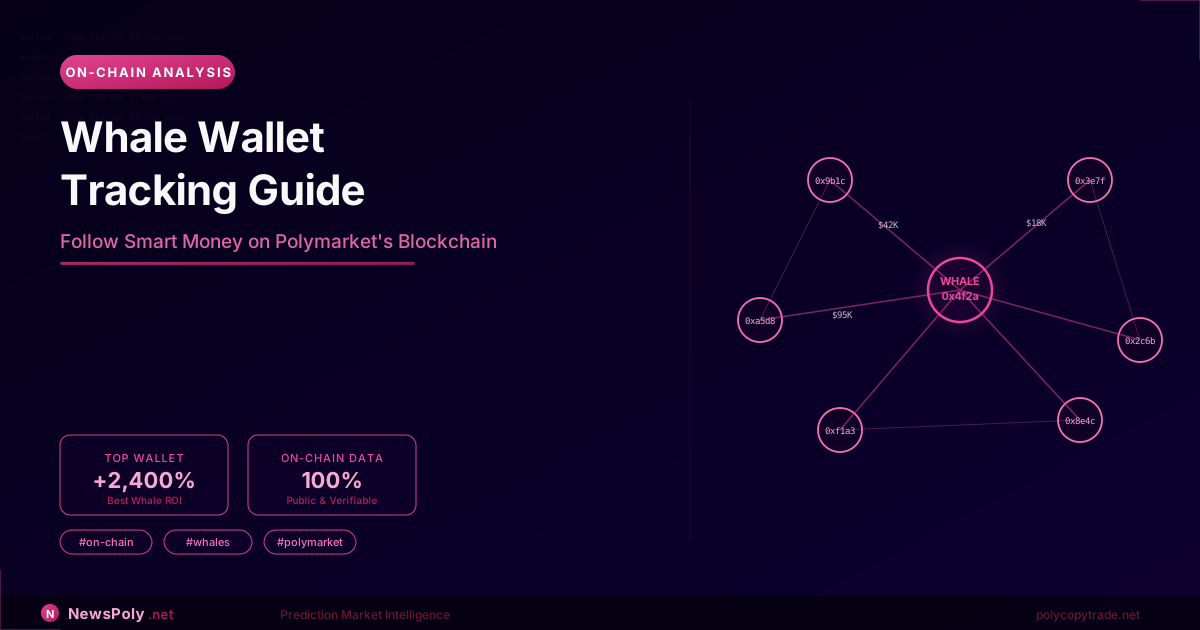
This research stack connects directly to the whale tracking methodology in our whale wallet tracking guide: sophisticated DeFi market participants who combine protocol knowledge with on-chain market monitoring represent the category of Polymarket traders most worth tracking in Web3-specific markets.
For traders who want to access this DeFi market expertise without maintaining a full protocol research workflow, PolyCopyTrade allows you to mirror positions from wallets with demonstrated track records in crypto and DeFi categories — effectively delegating the domain expertise requirement to the platform’s trader selection process. How this works technically is covered in our copy trading guide.
Position Sizing and Risk Management for Protocol Markets
DeFi protocol markets carry a specific risk that other market categories don’t: resolution ambiguity driven by technical complexity. If terms like EIP, hard fork, TVL, or DAO governance are unfamiliar, the Polymarket glossary covers the key prediction market and Web3 terminology used throughout this guide. A market asking whether “Ethereum’s next upgrade will include EIP-XXXX” can become contested if the EIP is included in a modified form. Before sizing any protocol market position, verify:
- Resolution source specificity — Does the market resolve on a specific block explorer, a developer announcement, or a community consensus? Protocol markets with vague resolution criteria carry additional risk
- Timeline risk — Protocol markets with distant resolution dates carry compounding uncertainty; apply lower-end position sizing (1–2% bankroll) for markets more than 90 days from resolution
- Correlation with broader crypto markets — L2 TVL markets are correlated with ETH price; if you hold both ETH price target markets and L2 TVL markets, they are not independent positions. Apply the correlation risk framework from our risk management guide
Frequently Asked Questions
Do Ethereum upgrade markets resolve on official Ethereum Foundation announcements?
Resolution criteria vary by market. Most Ethereum upgrade markets on Polymarket resolve based on mainnet activation at a specific block number or by a specific date — verifiable directly on-chain via Etherscan or equivalent block explorers. Some markets resolve on the Ethereum Foundation’s official blog announcement. Always read the specific resolution criteria for the market you’re trading, as there can be meaningful differences between “activated by date X” and “officially announced by date X.”
How liquid are DeFi protocol markets compared to other Polymarket categories?
Generally less liquid than major political or sports markets. High-profile Ethereum upgrade markets can reach hundreds of thousands in liquidity; specific DAO governance vote markets may have only tens of thousands. Lower liquidity means higher execution costs and more frequent mispricing in both directions. For DeFi markets, checking available liquidity before sizing is especially important — a market with $20,000 total liquidity cannot accommodate a $5,000 position without significant price impact.
How do I find DeFi and protocol markets on Polymarket?
Search the Polymarket interface by protocol name (e.g., “Ethereum,” “Arbitrum,” “Uniswap”) or browse the Crypto category. During active upgrade cycles, Polymarket typically creates multiple related markets. For governance-specific markets, checking the DeFi governance calendar — Tally and Snapshot both maintain upcoming vote listings — and then searching Polymarket for related questions is more reliable than browsing the interface alone. For a broader guide to what’s available in the crypto category, see our Polymarket crypto markets guide.