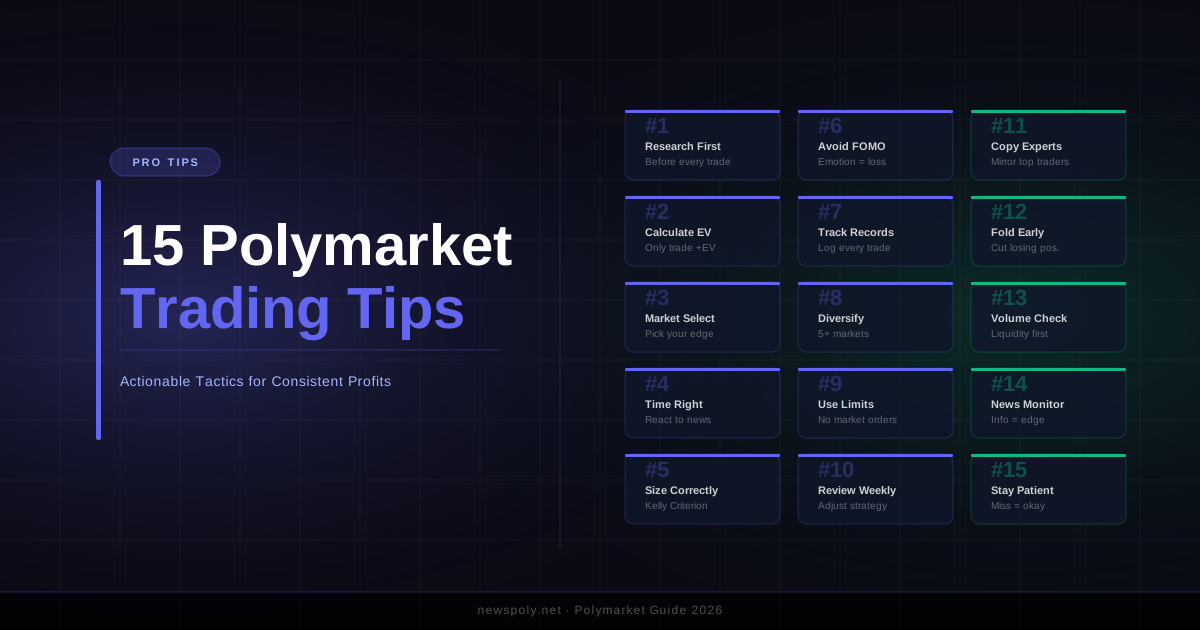
If you want consistent profits on Polymarket, you need more than luck - you need a repeatable system. These 15 Polymarket trading tips distill the core principles that separate profitable traders from the crowd: disciplined research, sharp probability thinking, controlled risk, and continuous self-improvement. Whether you are just moving past the basics or looking to tighten up an already profitable approach, applying even a handful of these tips will measurably improve your edge over time.
Before You Trade: The Right Mental Framework
Most traders lose not because they lack information but because they lack discipline. Polymarket rewards patience and calibration, not aggression. Before placing a single dollar, you need to accept that each trade is a bet on probability, not a guarantee. Your job is not to be right - it is to find markets where the price is wrong relative to your estimate of the true probability.
Think like an insurance actuary, not a gambler. Every position you take should have a documented reason grounded in evidence. If you cannot explain why 60% is the correct probability for a given outcome in two sentences, you are not ready to trade it. This mindset shift alone will put you ahead of the majority of participants on the platform.
Avoid the trap of trading for excitement. The markets that feel the most exciting - close elections, breaking news events, viral social media predictions - are also the most heavily traded and most efficiently priced. Your edge is usually found in the quieter corners of the platform where fewer participants are paying close attention.
Tips 1-5: Research, Probability, Value, Timing, and Market Selection
Tip 1: Build a Research Process Before Every Trade
Profitable traders do not wing it. Before entering any market, they follow a consistent research process: identify the key variables, find credible sources, assess base rates, and quantify uncertainty. For political markets, this means polling aggregators, electoral history, and fundamentals. For economic markets, it means institutional forecasts and historical data. Document your reasoning before trading so you can review it later and spot patterns in where your process breaks down.
Strong research is the foundation of calculating expected value accurately - the single most important skill you can develop as a prediction market trader.
Tip 2: Price Your Own Probability Before Looking at the Market
One of the most damaging habits a trader can have is anchoring to the current market price when forming their estimate. Always determine your own probability first, write it down, then compare it to what the market is offering. If the market price is 55% and your independent estimate is 70%, that gap represents potential edge. If you look at the market first and then rationalize a similar number, you are not trading - you are just following the crowd.
Tip 3: Only Trade When You Have Genuine Edge
Not every market is worth trading. The best expected value framework tells you to pass on markets where your estimate matches the market price, even if you are confident in your view. Edge requires disagreement with the market. If the market is pricing something at 72% and you also think it is 72%, there is no bet to make regardless of how strong your conviction is. Patience in selecting your spots is one of the highest-impact trading habits you can develop.
Tip 4: Understand Market Timing and Liquidity Windows
Polymarket prices are not static. They move as new information arrives, as resolution dates approach, and as large traders enter or exit positions. Understanding when to enter matters as much as identifying the right markets. Early in a market's life, prices are often inefficient because few traders have done deep research. As resolution approaches, prices tend to converge toward the true probability. Entering early with a well-researched view and holding through the convergence is one of the most reliable paths to profit. Read more about how timing intersects with liquidity on Polymarket before placing larger trades.
Tip 5: Focus Your Attention on a Few Market Categories
Specialist traders consistently outperform generalists on prediction markets. Pick two or three categories - political elections, Federal Reserve decisions, crypto prices, sports outcomes - and go deep. Build your reference data, your source list, and your historical base rates for those categories. You will develop pattern recognition that casual traders simply cannot replicate because they spread themselves too thin. See the best Polymarket markets to trade for guidance on where the most consistent opportunities appear.
Tips 6-10: Bankroll, Position Sizing, Biases, News, and Tracking
Tip 6: Treat Your Bankroll as a Business Asset
Your trading bankroll is not spending money - it is capital deployed in a probability-based business. That means protecting it with the same seriousness a fund manager would. Set a hard rule: never risk more than a fixed percentage of your total bankroll on any single market. Most experienced traders cap single-position exposure at 2-5% of total capital. This ensures that even a string of bad outcomes - which will happen even with good processes - cannot wipe out your ability to keep trading. For a thorough breakdown, review Polymarket risk management principles before scaling up your positions.
Tip 7: Use Kelly Criterion to Size Positions Mathematically
Guessing how much to bet is one of the most common and costly mistakes on prediction markets. The Kelly Criterion gives you a mathematically optimal bet size based on your estimated edge and the market odds. It prevents both over-betting (which leads to ruin) and under-betting (which leaves profit on the table). Most experienced traders use a fractional Kelly - typically 25-50% of the full Kelly recommendation - to account for estimation error. The complete Kelly Criterion guide for Polymarket walks through the exact formula and practical applications.
Tip 8: Identify and Neutralize Your Cognitive Biases
Every trader carries systematic biases that warp probability estimates. Recency bias makes recent events feel more probable. Outcome bias makes you judge past decisions by their results rather than their process. Overconfidence bias makes your probability estimates too extreme. The first step is knowing which biases affect you most. Keep a trading journal and periodically review your closed positions - not just whether you won or lost, but whether your initial probability estimate was well-calibrated. The guide to cognitive biases in Polymarket trading provides a systematic framework for bias detection and correction.
Tip 9: Develop a Structured Approach to News Trading
Breaking news can create brief windows of mispricing as markets adjust to new information. However, reacting emotionally to news is far more likely to hurt you than help you. A structured news-trading approach means: (1) identify how the new information changes the base probability, (2) estimate how much of the news is already priced in by the current market move, and (3) only trade if your revised estimate still shows meaningful edge after accounting for the market's reaction. Speed matters, but accuracy matters more. A fast wrong trade is worse than a slow right one.
Tip 10: Track Every Trade and Review Weekly
You cannot improve what you do not measure. Maintain a trade log that records: market name, entry price, your estimated probability, position size, exit price, outcome, and a brief note on your reasoning. Review this log every week. Look for patterns: Are you systematically overconfident in certain market types? Do you trade better in the morning or evening? Are your largest positions your best or worst performers? Data-driven self-review is the fastest path to improvement, and it costs nothing except discipline.
Tips 11-15: Copy Trading, Diversification, Patience, Exits, and Review Cycles
Tip 11: Use Copy Trading to Extend Your Coverage
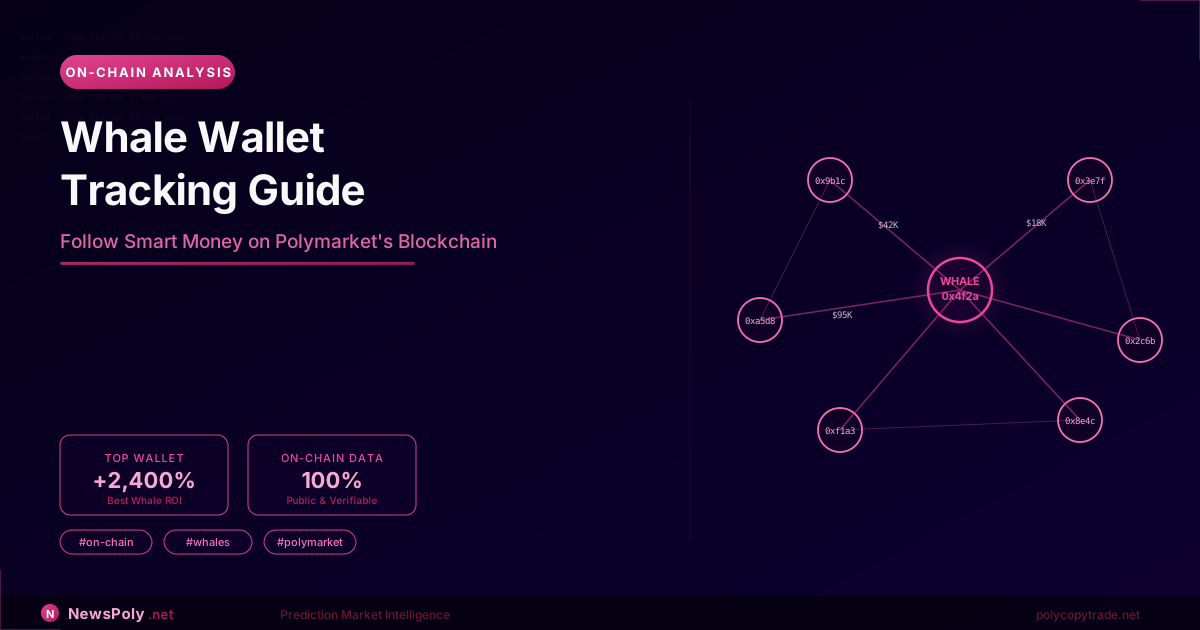
No individual trader can research every active market on Polymarket. Copy trading lets you benefit from the expertise of specialists in categories outside your own focus areas. By mirroring the positions of traders with verified track records in specific domains, you gain exposure to well-researched bets without requiring the time investment of original research. This is not a shortcut around developing your own skills - it is a portfolio diversification tool that lets you allocate capital efficiently across more opportunities than you could cover alone.
Tip 12: Diversify Across Uncorrelated Markets
Concentration risk is real on Polymarket. If all your open positions are in US political markets and a single piece of polling data moves the entire category, your whole portfolio moves at once. True diversification means holding positions in markets whose outcomes are genuinely independent - mixing political, economic, crypto, sports, and science markets so that no single event can simultaneously affect all your positions. For a structured approach to building a balanced book, see the Polymarket portfolio management guide.
Tip 13: Patience Is a Position - Avoid Overtrading
One of the most reliable findings across all trading research is that trading frequency is negatively correlated with returns for most retail participants. Every trade has a spread cost on Polymarket, and more importantly, every unnecessary trade exposes you to mistakes. The discipline to sit on cash and wait for genuinely high-edge opportunities is a skill that takes time to develop but pays enormous dividends. When in doubt, do not trade. The market will always have more opportunities tomorrow.
Tip 14: Know Your Exit Criteria Before You Enter
Every position should have a pre-defined exit plan. This means two things: (1) at what price will you take profit, and (2) under what circumstances will you cut a losing position early. Without a plan, you will be making emotional decisions at the worst possible moments - when prices are moving against you and your judgment is most clouded. If new information invalidates your original thesis, exit the position regardless of your current profit or loss. Your thesis, not your entry price, should drive exit decisions. Avoid the common Polymarket beginner mistakes that stem from holding losers too long out of hope rather than evidence.
Tip 15: Run a Monthly Performance Review Cycle
Beyond weekly trade reviews, conduct a deeper monthly performance analysis. Examine your overall return, your win rate by market category, your average edge at entry versus outcome, and your biggest winning and losing positions. Identify one or two specific improvements for the coming month - not vague resolutions, but concrete changes like "I will price my own probability before checking the market on every trade" or "I will reduce maximum position size from 8% to 5% of bankroll." Systematic improvement compounds over time just as capital does.
15 Polymarket Trading Tips: Summary Table
| Tip | Category | Difficulty | Impact |
|---|---|---|---|
| 1. Build a research process | Research | Medium | High |
| 2. Price your own probability first | Probability | Easy | High |
| 3. Only trade when you have edge | Value | Easy | High |
| 4. Understand timing and liquidity | Timing | Medium | High |
| 5. Specialize in market categories | Market Selection | Easy | High |
| 6. Treat bankroll as business capital | Bankroll | Easy | High |
| 7. Size positions with Kelly Criterion | Position Sizing | Hard | High |
| 8. Neutralize cognitive biases | Psychology | Hard | High |
| 9. Structure your news trading | News Trading | Hard | Medium |
| 10. Track every trade and review weekly | Tracking | Easy | High |
| 11. Use copy trading strategically | Copy Trading | Easy | High |
| 12. Diversify across uncorrelated markets | Diversification | Medium | High |
| 13. Avoid overtrading - patience pays | Discipline | Medium | High |
| 14. Define exit criteria before entry | Exit Strategy | Medium | High |
| 15. Run a monthly review cycle | Self-Improvement | Easy | High |
What Separates Profitable Traders from the Rest
The gap between profitable and unprofitable Polymarket traders is rarely about raw intelligence or access to information. Most serious participants are reading the same news, following the same forecasters, and watching the same markets. The difference is process: profitable traders have systematic, documented approaches that they apply consistently, while losing traders make ad-hoc decisions that feel right in the moment but lack any underlying structure.
Calibration is the single most important technical skill. A well-calibrated trader's 70% predictions come true about 70% of the time across a large enough sample. Most traders are overconfident - their 70% predictions come true only 55-60% of the time. Closing this calibration gap through regular review and deliberate practice is worth more than any single market insight. Your long-term returns are mathematically determined by the quality of your probability estimates, not by lucky streaks.
Emotional detachment from outcomes is equally critical. A losing trade executed according to a good process is a success. A winning trade executed on a hunch is a failure in the making. Profitable traders evaluate their decisions based on the quality of the process at the time of the decision, not the outcome. This is psychologically difficult but essential - outcome-based thinking leads to abandoning good strategies after normal variance and sticking with bad ones after lucky runs.
Finally, profitable traders think about long-term capital preservation first and profits second. They understand that a 50% drawdown requires a 100% return just to break even. They size positions to survive bad runs, not to maximize gains in good ones. This conservative approach feels slow at first, but compounding returns from a preserved bankroll consistently outperforms the boom-and-bust cycles of aggressive traders over any meaningful time horizon.
Frequently Asked Questions
How many Polymarket trading tips should a beginner focus on first?
Beginners should start with three: price your own probability before checking the market (Tip 2), only trade when you have genuine edge (Tip 3), and track every trade (Tip 10). These three habits build the foundation for everything else. Once they are automatic - typically after 30-50 trades - you can layer in bankroll rules, Kelly sizing, and bias awareness.
How much capital do I need to start applying these trading tips seriously?
You can apply every tip in this guide with as little as $100. The percentage-based bankroll rules (never risk more than 2-5% on a single market) scale down to any starting amount. The critical thing is not the absolute dollar amount but the discipline of following your process on every trade. Good habits formed at small scale transfer perfectly to larger bankrolls.
Do Polymarket trading tips apply to all market categories equally?
The core principles - independent probability estimation, edge-based entry, Kelly sizing, bias awareness - apply to every category. The research methods vary: political markets require polling and historical electoral data, economic markets require institutional forecasts, crypto markets require on-chain data and sentiment analysis. The framework is universal; the inputs are category-specific. This is why specializing in two or three categories (Tip 5) accelerates your improvement so dramatically.
Is copy trading a substitute for learning these tips?
No - copy trading is a complement, not a substitute. Understanding these principles helps you select better traders to copy, evaluate their strategies critically, and manage your own risk around copied positions. A copy trader who understands expected value and Kelly sizing will significantly outperform one who simply follows signals blindly. Use copy trading to extend your market coverage; use these principles to manage it intelligently.
How long does it take to see consistent profits applying these Polymarket trading tips?
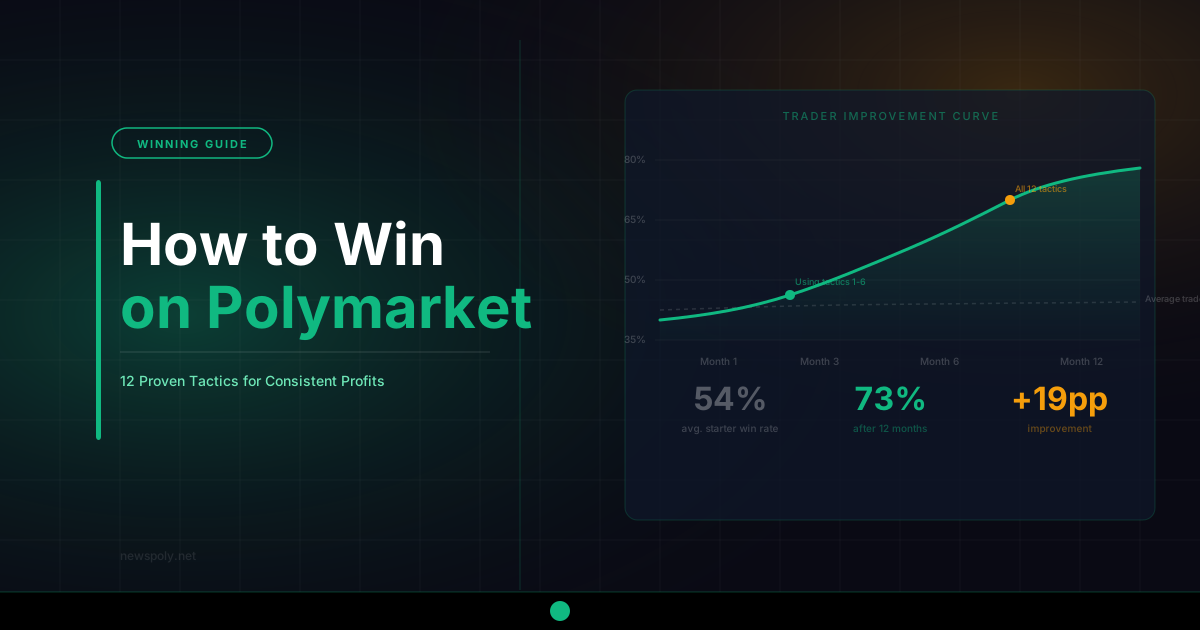
Most traders see measurable improvement in calibration within 60-90 days of systematic tracking and review. Consistent profitability - meaning positive returns over rolling 3-month periods - typically takes 3-6 months of disciplined practice. The timeline accelerates dramatically with structured review (Tips 10 and 15) and deliberate bias correction (Tip 8). There is no shortcut, but the compounding nature of skill development means the curve steepens significantly after the first 100 logged trades.