Every trade on Polymarket passes through an order book — a live, ranked list of every open buy and sell offer in the market. Most traders glance at a price and click “Buy” without ever looking at what’s underneath. That’s a mistake. The order book reveals who is sitting at what price, how much liquidity is available before the price moves, and whether the market is efficiently priced or ripe for an edge. This guide breaks down the Polymarket CLOB system from first principles so you can read any order book and extract actionable information from it.
What Is a Central Limit Order Book (CLOB)?
A Central Limit Order Book, or CLOB, is the matching engine at the heart of most modern financial markets. It works by collecting every open limit order — both buy orders (bids) and sell orders (asks) — sorting them by price, and matching them whenever a buyer’s price meets a seller’s price.
The word “central” means all orders flow through a single shared book, so every participant sees the same prices and competes on equal footing. The word “limit” distinguishes it from a market order system: participants specify the price they are willing to transact at, rather than accepting whatever price the market currently offers.
When you place a buy limit order at $0.65 per YES share, your order sits in the book until one of two things happens: a seller posts at $0.65 or lower (triggering a match), or you cancel the order. Until then, your order is publicly visible to everyone looking at the book — you are making liquidity for the market.
The CLOB model is used by stock exchanges, futures markets, crypto spot exchanges, and — crucially for our purposes — Polymarket. Understanding the CLOB is foundational to everything from placing smarter limit orders to running a full market-making strategy.
How Polymarket’s CLOB Differs from AMMs
Before Polymarket adopted the CLOB model, many prediction markets and DeFi protocols used Automated Market Makers (AMMs). An AMM replaces the order book entirely with a mathematical formula — typically a constant-product curve — that automatically sets prices based on the ratio of tokens in a liquidity pool.
The AMM approach has one big advantage: liquidity is always available, because the formula never runs out of quotes. But it comes with serious drawbacks for prediction markets specifically:
- Guaranteed slippage: Every trade moves the price along the curve, so large orders always pay more than the quoted price.
- No price improvement: You cannot place a limit order and wait for a better fill — you take the formula’s price or you don’t trade.
- Impermanent loss: Liquidity providers lose value as the market resolves toward 0 or 1, making capital provision unattractive for informed participants.
Polymarket’s CLOB solves all three. Sophisticated traders post tight limit orders, slippage only occurs when the book is thin, and market makers can manage their inventory precisely. The result is a deeper, more efficient liquidity environment than any AMM can produce on a mature market.
The trade-off is that thinly traded markets on the CLOB can have wide spreads and low depth, whereas an AMM would always show some liquidity. This is why reading the order book matters: you need to know whether the market you are entering has real depth or is just a few orders wide.
Reading the Order Book: Bids, Asks, and Depth
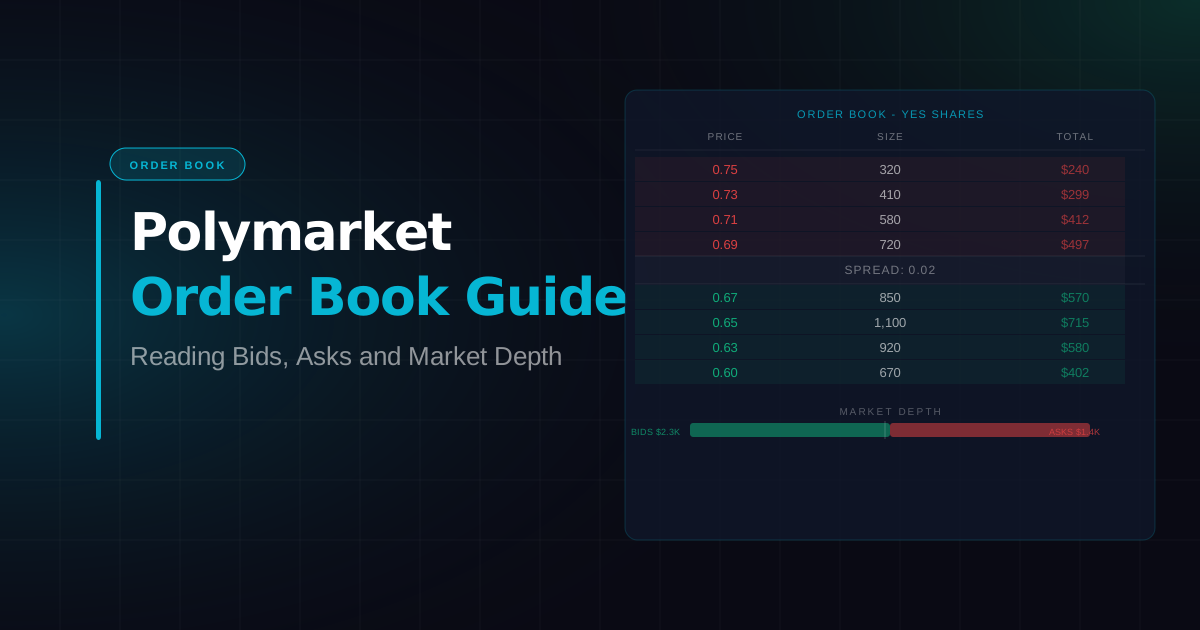
A standard Polymarket order book display shows two columns: the bid side on the left (buyers) and the ask side on the right (sellers). Each row shows a price level and the total quantity available at that price.
| Side | Price (per YES share) | Size (shares) | Cumulative Depth |
|---|---|---|---|
| Ask (sell) | $0.71 | 1,840 | 4,230 |
| Ask (sell) | $0.69 | 2,390 | 2,390 |
| Best Ask | $0.67 | 3,100 | — |
| Best Bid | $0.65 | 3,280 | — |
| Bid (buy) | $0.63 | 2,560 | 5,840 |
| Bid (buy) | $0.61 | 1,870 | 7,710 |
Key terms to know:
- Best bid: The highest price any buyer is currently offering. In the table above, $0.65. If you are selling, this is the best price you can get immediately.
- Best ask: The lowest price any seller is currently offering. Above, $0.67. If you are buying with a market order, this is your immediate fill price.
- Cumulative depth: The total shares available from the best price up to that level. A buyer wanting 4,230 YES shares would need to lift the best ask ($0.67 for 3,100 shares) and then continue into the $0.69 level for the remaining 1,130 shares.
The depth chart visualises this as a curve — bid depth sloping down to the left, ask depth sloping up to the right, with a gap at the spread. A steep, narrow curve means shallow liquidity and large price impact per dollar traded. A flat, wide curve means abundant liquidity and minimal slippage.
Bid-Ask Spread on Prediction Markets
The bid-ask spread is the difference between the best ask and the best bid. In the example above it is $0.67 − $0.65 = $0.02, or 2 cents per share.
On a prediction market, spread carries special significance because share prices are probabilities bounded between $0.00 and $1.00. A 2-cent spread on a $0.65 market represents roughly a 3.1% round-trip cost — you lose that much just by buying at the ask and immediately selling at the bid. On a $0.10 market (a long-shot outcome), the same 2-cent spread would represent a 20% round-trip cost, which is enormous.
Spreads on Polymarket vary dramatically by market quality:
- High-volume markets (major elections, Fed rate decisions): spreads often below 1 cent, sometimes as tight as 0.2–0.5 cents.
- Mid-tier markets (state-level politics, sports championships): spreads of 1–3 cents are typical.
- Low-volume or niche markets: spreads of 5–15 cents are common, and depth beyond the best level may be essentially zero.
Always check the spread before entering. A wide spread is not necessarily a reason to avoid a market — it can indicate mispricing that the spread compensates for — but it is a cost you must build into your expected value calculation. See our Polymarket expected value guide for the full formula.
How Large Orders Move the Price
When a market order or an aggressive limit order is placed for more shares than the best level can fill, it “walks the book” — consuming each level in turn until the order is fully filled or the trader cancels the remainder. This price movement is called market impact or slippage.
Using the table above: a buyer placing a market order for 6,000 YES shares would fill:
- 3,100 shares at $0.67 (best ask, fully consumed)
- 2,390 shares at $0.69 (second level, fully consumed)
- 510 shares at $0.71 (partial fill of the third level)
The average fill price would be approximately $0.6843, not $0.67. More importantly, the best ask has now reset to $0.71 — the market has moved 4 cents on a single order. Anyone watching the last-trade price would see a sudden jump and might misread it as new information entering the market.
This is why large traders almost always use limit orders split across multiple price levels, and why watching for sudden moves on thin books is a legitimate signal in whale-tracking strategies.
Using Order Book Data to Gauge Market Sentiment
The order book is not just a tool for execution — it is a real-time sentiment gauge. Several patterns carry informational value:
Order book imbalance. If the total bid depth significantly exceeds ask depth (say, 15,000 bid shares vs. 4,000 ask shares), it signals more buying pressure than selling pressure. Prices tend to move upward in imbalanced books as the available sell-side supply is absorbed. The reverse signals selling pressure.
Thin ask walls vs. bid walls. A large single order at one price level — a “wall” — can signal a trader with a strong conviction price target. An ask wall at $0.80 might represent a large holder who is willing to sell significant size there. Watch whether these walls are genuine (they persist as price approaches) or spoofed (they disappear just before being hit).
Sudden depth withdrawal. When large orders are cancelled right before a resolution event, it can indicate the market maker has received news and is pulling risk. This kind of order book behaviour is an advanced signal that experienced traders combine with chart and volume analysis.
Spread compression before events. As a major resolution event approaches and uncertainty collapses, spreads typically tighten as market makers compete for the remaining flow. Widening spreads in the final hours before resolution can indicate disagreement or breaking information.
Order Book Strategies: Thin Markets and Front-Running Resistance
Identifying thin markets. Before entering any position, pull up the order book and check total depth within 2–3 cents of the best bid and ask. If the combined depth is less than a few hundred dollars of notional value, you are in a thin market. In thin markets:
- Use limit orders exclusively — never market orders.
- Size down aggressively. Even a modest $500 order can move the market by several cents.
- Be patient. Post your limit order and wait; chasing with market orders punishes you heavily.
- Consider whether the thin book reflects lack of interest or genuine uncertainty — the latter may be a liquidity provision opportunity if you are confident in your edge.
Front-running resistance. Because the CLOB is transparent, sophisticated participants can observe your open limit orders and trade around them — a practice loosely called “front-running” in prediction market context. Practical defences include:
- Iceberg orders: Some interfaces allow you to show only part of your order at any one time, concealing total size.
- Time-limited orders: Setting short expiries reduces the window in which others can react to your visible order.
- Placing away from round numbers: Large orders clustered at $0.50, $0.60, and $0.70 are predictable. Offsetting by a cent or two makes your position less readable.
Advanced order management is explored in depth in the limit orders guide and is a key component of any serious market-making operation.
Tools for Viewing Polymarket Order Book Data
Polymarket’s native interface shows a simplified order book. For deeper analysis, several tools expose the full CLOB data:
- Polymarket native UI: The trade panel on any market page shows the best bid, best ask, and a basic depth indicator. Adequate for single trades but lacks historical data or visualisation tools.
- Polymarket CLOB API: The official REST and WebSocket API exposes the full order book in real time, including all price levels and sizes. Free to access; requires basic coding to consume. The on-chain data guide covers authentication and endpoints in detail.
- Polymarket Explorer (community tools): Several community-built dashboards aggregate order book snapshots and show depth history over time. These are invaluable for spotting patterns that only emerge across multiple resolution cycles.
- On-chain data indexers: Because Polymarket settles on Polygon, every matched trade is recorded on-chain. Indexers like Dune Analytics host public dashboards that reconstruct order flow, large trades, and wallet-level activity from raw blockchain data.
Combining the live order book from the API with on-chain historical data gives a complete picture of market microstructure — the same toolkit used by professional prediction market traders and the algorithmic systems that track whale activity in real time.
Putting It All Together
The Polymarket CLOB is a mature, exchange-grade order matching system. Every time you trade without checking the order book, you are leaving information on the table — about your likely fill price, the true depth of liquidity, and the sentiment signal embedded in how orders are stacked. Build a habit of checking the book before every trade:
- What is the spread, and is it reasonable relative to the share price?
- Is there enough depth to fill my order without significant slippage?
- Is the book balanced, or does imbalance suggest directional pressure?
- Are there any unusual walls or thin patches that might signal informed activity?
These four questions take ten seconds. Over hundreds of trades, they meaningfully improve your average entry price and prevent the costly mistakes that come from treating a thin prediction market like a deep equity exchange. Pair this analysis with the broader context from the liquidity guide and the charts guide and you have a complete framework for professional-grade Polymarket execution. For a wider view of how order book reading fits into a full trading system, see top Polymarket trading strategies.