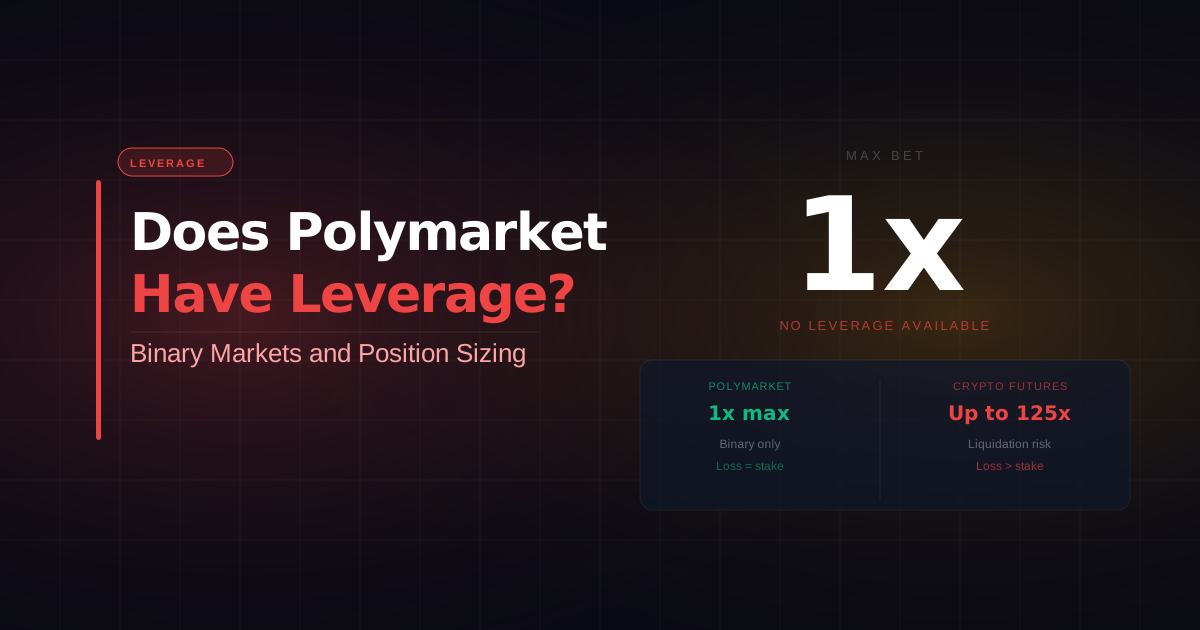
The short answer: Polymarket does not offer leverage or margin trading. There are no margin accounts, no borrowed funds, no liquidation engines, and no margin calls. Every dollar you risk is a dollar you own. But that answer misses something important — the binary structure of prediction markets creates a form of implicit leverage that every serious trader needs to understand before sizing positions.
This guide explains exactly how that implicit leverage works, the maths behind it, how it compares to CFD and crypto futures leverage, and how to account for it when managing risk.
How Traditional Leverage Works (and Why Polymarket Has None)
In traditional leveraged trading — CFDs, forex margin accounts, crypto perpetual futures — leverage means borrowing capital from a broker or exchange to control a position larger than your account balance. A 10x leveraged position on Bitcoin worth $10,000 requires only $1,000 of your own capital. The exchange provides the other $9,000. If the trade moves against you past a certain threshold, the exchange liquidates your position to recover the loan. If the price gaps through your liquidation level, you can lose more than your initial deposit.
Polymarket operates on a completely different model. It is a decentralised prediction market built on the Polygon blockchain. You buy shares in binary outcomes: YES or NO. Each share is worth $1.00 if the outcome resolves in your favour, and $0.00 if it resolves against you. No borrowing. No margin accounts. No liquidation. The maximum you can ever lose on any position is the amount you paid for those shares — full stop.
This makes Polymarket structurally safer than leveraged trading in the traditional sense. You cannot blow up your brokerage account, receive a margin call at 3am, or lose more than you deposited.
Implicit Leverage: How Binary Markets Create Natural Leverage Effects
Here is where it gets interesting. When you buy YES shares at a low price, the potential upside relative to your stake is very large — and that ratio has the same mathematical structure as leverage.
Consider a market where YES is trading at $0.10 (10% implied probability). You buy 100 shares for $10. If the market resolves YES, you collect $100 — a $90 profit on a $10 stake. That is a 10x return on your capital. You have achieved leverage-equivalent returns without borrowing anything.
The formula is simple:
Implicit leverage ratio = 1 ÷ price
So:
- Buy YES at $0.05 → implicit leverage of 20x
- Buy YES at $0.10 → implicit leverage of 10x
- Buy YES at $0.25 → implicit leverage of 4x
- Buy YES at $0.50 → implicit leverage of 2x
- Buy YES at $0.90 → implicit leverage of 1.1x
The same logic applies to buying NO shares in any of those markets. Buying NO at $0.10 (meaning the market gives YES a 90% chance) gives you the same 10x implicit leverage on your NO position.
The Critical Difference: Probability Is the Risk, Not Liquidation
In leveraged trading, the danger is the liquidation price. The market moves against you, you get liquidated, and you lose your margin. In binary markets, there is no liquidation price — but the low-probability nature of cheap-share markets is the risk equivalent.
Buying YES at $0.05 does not just give you 20x implicit leverage — it means the market considers this outcome only 5% likely to occur. You are putting money on a long shot. The implicit leverage is high precisely because the probability of a positive resolution is low. This is not a coincidence; it is the same relationship.
Understand this clearly: cheap shares are not a free-lunch leverage play. They are a compound risk. The leverage effect is real, but it comes bundled with a low probability of ever collecting the payout. Most 5-cent YES positions expire worthless. Most 5-cent NO positions also expire worthless. The market price is already reflecting that.
For a full framework on assessing whether you have a genuine edge in these trades, see our guide on Polymarket expected value.
Practical Examples: $100 Stake at Various Price Points
To make this concrete, here is what a $100 stake looks like at different entry prices, assuming binary resolution:
| Entry Price | Shares Bought | If Resolves YES | If Resolves NO | Profit (YES) | Loss (NO) |
|---|---|---|---|---|---|
| $0.05 | 2,000 | $2,000 | $0 | +$1,900 | -$100 |
| $0.10 | 1,000 | $1,000 | $0 | +$900 | -$100 |
| $0.25 | 400 | $400 | $0 | +$300 | -$100 |
| $0.50 | 200 | $200 | $0 | +$100 | -$100 |
| $0.90 | 111 | $111 | $0 | +$11 | -$100 |
Notice the asymmetry at the high end: buying YES at $0.90 gives you only $11 profit potential against a $100 loss. That is an 9:1 risk-to-reward ratio working against you. This is the near-certain market trap that catches many traders who are new to prediction markets. For more on that specific risk, see our Polymarket risk management guide.
How This Compares to CFD and Crypto Futures Leverage
The key structural differences between implicit Polymarket leverage and real leverage in CFDs or crypto futures:
No margin calls. On a leveraged futures trade, if the market moves against you past a threshold, you receive a margin call requiring additional funds or face liquidation. On Polymarket, there is no ongoing exposure — your maximum loss is fixed at the moment you buy the shares.
No liquidation cascade risk. In crypto futures, a sharp move can trigger cascading liquidations that accelerate against you. Polymarket positions simply expire. There is no feedback loop.
Loss is always capped at stake. With 20x leverage on a futures contract, a 5% adverse move wipes your entire margin. On Polymarket, a 100% adverse outcome — complete resolution against you — only loses what you paid. No more.
No funding rates. Perpetual futures charge funding rates that can erode your position over time even if the price stays flat. Polymarket positions have no carrying cost once entered (beyond gas fees on entry).
The implicit leverage of binary markets is real, but it is structurally far safer than borrowed leverage. The risk is front-loaded into the initial price you pay, not open-ended.
Applying the Kelly Criterion to Implicit Leverage
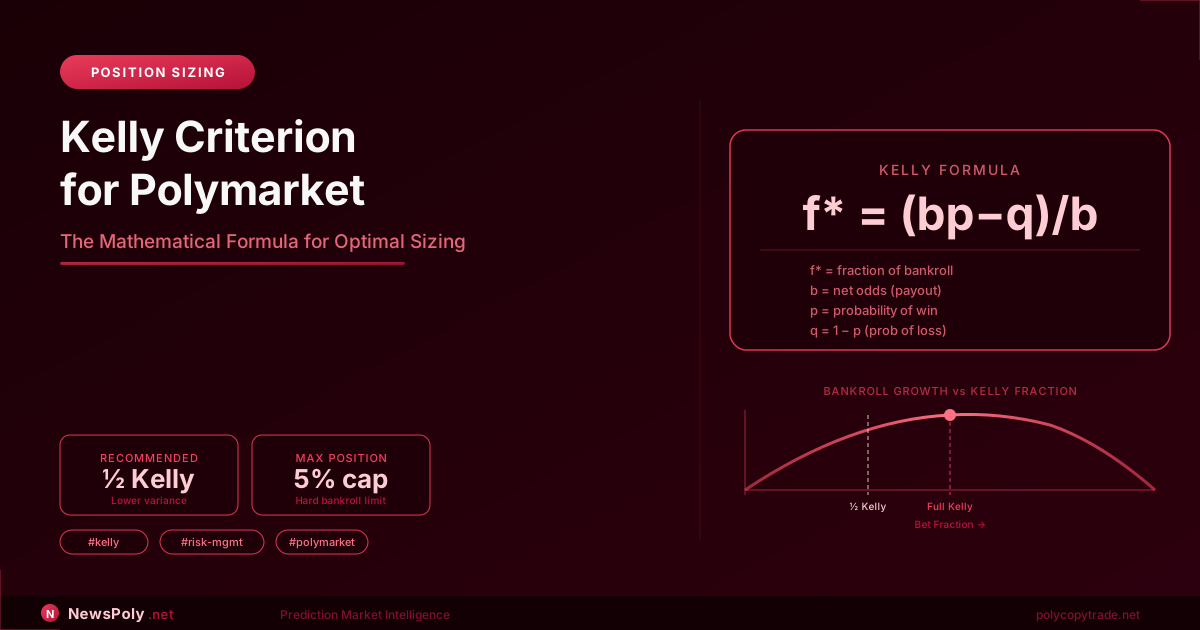
The Kelly Criterion is the standard mathematical framework for optimal position sizing when you have an edge. It becomes particularly important when implicit leverage is high, because the Kelly formula will tell you to size down significantly on low-price, high-leverage markets — exactly when the emotional temptation is to size up chasing large returns.
The Kelly formula for binary outcomes is:
Kelly % = (p × b – q) ÷ b
Where:
- p = your estimated probability of YES resolving
- q = 1 – p (probability of NO resolving)
- b = net odds received (payout per dollar risked, which is (1 – price) ÷ price)
Example: You believe a market has a 15% true probability. The market is priced at $0.08 (8% implied). Your edge is 7 percentage points.
- p = 0.15, q = 0.85
- b = (1 – 0.08) ÷ 0.08 = 0.92 ÷ 0.08 = 11.5
- Kelly % = (0.15 × 11.5 – 0.85) ÷ 11.5 = (1.725 – 0.85) ÷ 11.5 = 0.875 ÷ 11.5 ≈ 7.6%
That 7.6% is the full Kelly. Most experienced traders use half-Kelly or quarter-Kelly to account for probability estimation errors. In this case: 3.8% or 1.9% of bankroll. Not small — but very manageable. If you had thought "this is a 20x leverage play, I should go big," you might have sized at 15–20% of bankroll. Kelly shows you why that is wrong.
The formula also works in the other direction. If your edge estimate is weak or your probability assessment is uncertain, Kelly will suggest very small positions. This is the discipline that protects you from chasing large nominal returns with inappropriate position sizes. For a deeper exploration of how this ties into Polymarket position sizing practice, see our dedicated guide.
Why Crypto Futures Traders Search for “Polymarket Leverage”
A significant portion of people searching for this topic are traders migrating from crypto futures who are used to operating with explicit leverage and want to know how Polymarket compares. The honest answer is: it compares favourably from a risk perspective, but unfavourably if your goal is to amplify small capital into large positions.
On crypto futures, $100 with 100x leverage gives you $10,000 of notional exposure. The downside is that a 1% adverse move liquidates you entirely. Polymarket’s implicit leverage on a 1-cent market is 100x — but to get $10,000 of notional exposure, you still need $100 in actual capital. The leverage amplifies your return-on-stake, not your exposure-relative-to-capital.
The practical upside for traders moving from futures: no funding rates, no liquidations, no margin calls, and no counterparty risk beyond the smart contract. Many experienced traders find this a more controlled environment for developing edge. The most common mistakes futures traders make when transitioning to prediction markets involve misjudging this structural difference. For a foundation in how Polymarket works before diving into leverage mechanics, our Polymarket beginner guide covers the core structure of binary markets from the ground up.
Alternatives If You Want True Leverage on Prediction-Adjacent Trades
If you genuinely want traditional leverage on event-driven trades, the options are:
Crypto options. You can buy calls or puts on crypto assets that may be correlated to events tracked on Polymarket. Options provide real leverage with capped downside (the premium you pay). Platforms include Deribit and Lyra Finance. Complexity is high; options pricing requires understanding implied volatility, not just direction.
Crypto perpetual futures. Available on Binance, Bybit, OKX, and others. Genuine leverage up to 100x on major assets. The risks are significant: funding rates, liquidation, and 24/7 market exposure. Only appropriate for experienced traders with robust risk management.
Prediction market aggregators with leverage layers. A small number of experimental protocols are exploring leveraged prediction markets, but none are mature or liquid enough to recommend as of early 2026. The space is evolving.
For most traders, the absence of leverage on Polymarket is a feature, not a bug. The implicit leverage from low-price binary markets is sufficient to generate large percentage returns on well-researched positions — without the liquidation risk that destroys most leveraged crypto traders. For a realistic look at what returns are achievable, see our guide on how to make money on Polymarket.
Frequently Asked Questions
Can I trade on margin on Polymarket?
No. Polymarket does not offer margin accounts, borrowed capital, or any form of traditional leverage. Every position is fully collateralised by your own funds. You buy shares with USDC from your wallet, and your maximum loss is the amount you spent on those shares. There is no mechanism to borrow against your positions or amplify exposure beyond your actual stake.
What is the maximum I can lose on a Polymarket position?
The maximum loss is exactly the amount you paid for your shares. If you buy 500 YES shares at $0.20 each, you spend $100 total. If the market resolves NO, you lose $100. You cannot lose more than this amount — there are no margin calls, no liquidations, and no open-ended downside. This hard cap on losses is one of the key structural advantages of prediction markets over leveraged trading.
How does Polymarket’s implicit leverage compare to crypto futures?
The implicit leverage ratio (1 ÷ price) is mathematically similar to traditional leverage in terms of return-on-stake. However, the crucial difference is that Polymarket leverage is fully collateralised and loss-capped. Crypto futures leverage is borrowed capital with liquidation risk — a 10x leveraged position can be wiped out by a 10% adverse move. A Polymarket position priced at $0.10 (also 10x implicit leverage) can only lose 100% of the stake, not more. There are also no funding rates on Polymarket positions.
Should I use low-price markets to get high implicit leverage?
Only if you have a genuine edge — meaning your estimated probability of resolution is materially higher than the market price implies. Buying YES at $0.05 to get 20x leverage is only rational if you believe the true probability is significantly above 5%. If the market is correctly priced, the implicit leverage is irrelevant because the expected value is zero. The Kelly Criterion will tell you to size these positions conservatively even when you do have edge, because the variance is very high. For a full framework, see our guide on Kelly Criterion for Polymarket.